
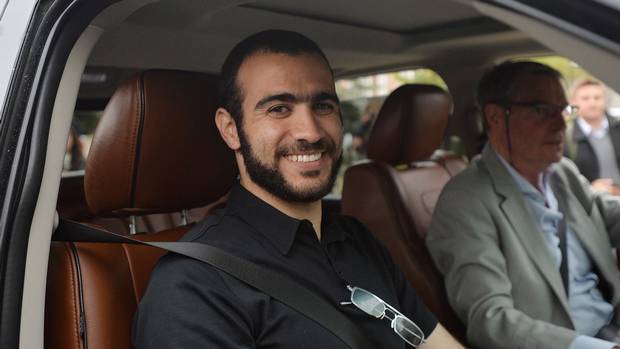
Omar Khadr, left, with his lawyer Dennis Edney arrives at Edney’s home in Edmonton, Thursday, May 7, 2015. The former Guantanamo Bay prisoner Omar Khadr got his first taste of freedom in almost 13 years.
(Nathan Denette/THE CANADIAN PRESS)
The tedium of UK elections was broken today by the news that former Guantanamo prisoner Omar Khadr (28) has been freed on bail in Canada while he appeals his conviction having spent 13 years in captivity.
In 2010, Khadr pleaded guilty to war crimes related to the murder of an army special forces medic, Sgt First Class Christopher Speer though he claimed this seemed to be his only option to leave Guantanamo. Campaigners supporting Khadr argued that he was just a 15 year old boy when he was picked up by US military in Afghanistan. American forces are viewed by many Afghans as an occupying army and therefore an enemy which must be resisted. Khadr has since been recognized as a child soldier by international NGOs including UNICEF and thus was entitled to rehabilitation not retribution. There also appeared to be conflicting testimonies surrounding the circumstances of the medic’s death.
Regarding the decision today, Global News reported that “Justice Myra Bielby ruled the government failed to prove that allowing Khadr out now would cause “irreparable harm” to Canada’s international treaty obligations.” (The treaty in question was to secure an agreement between the US and Canada that Khadr would serve out an 8 year sentence once transferred from one country to another.)
Back in 2012 I wrote to Public Safety Minister Vic Toews requesting he accept Khadr in Canada. Toews was quoted as saying to CTV’s Question Period , “I don’t agree he was a child soldier in the sense that he was somehow misled. The evidence is very clear. He was a convicted murderer, he’s a terrorist and that’s the basis I brought him back on.” See following link for my letter,
“Omar Khadr and Canada’s history of human rights violations”
Despite Khadr being classified as a minimum security risk, the Canadian government have announced their intention to challenge the bail decision from Justice Bielby. In his first video interview as a free man, Khadr appealed to the public, “give me a chance” and asked them to make an “informed decision” regarding himself.
See Omar Khadr in video interview
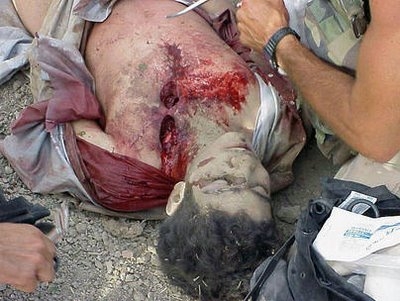
Omar Khadr age 15 shot and badly injured
Former Guantanamo detainee Moazzam Begg first encountered Khadr as a 16 year old in Bagram and gives a grim description of his wounds (as Omar himself was shot) and the conditions under which he was kept,
“I never really understood why but our military police guards would always refer to Khadr as ‘Buckshot Bob’ or simply ‘Buckshot’. His wounds didn’t seem to me as if they had been caused by the blast of a shotgun. They were much more horrific. Chunks of his chest and shoulder had been blown out – or so I’d assumed and, he was unable to see through one of his eyes because of the injuries he’d sustained, allegedly in a fire-fight with US troops. His chest looked like he’d just had a post mortem operation performed on him – whilst he was still alive. He was emaciated, fragile and quiet. But the rumour spread around about Khadr claimed that he’d launched a grenade-attack on unsuspecting US forces. Consequently, the military police units guarding us all treated Omar Khadr with open contempt and hostility. He was sometimes screamed at all night long; made to stack up crates of water bottles which were thrown down again; a hood placed over his head whilst his wrists were shackled to the ceiling. But, three years after my release from Guantánamo, and five since I last saw Khadr, I have come to realise the logic behind the name ‘Buckshot’. Photographs released by the US military this year show Khadr when he was first captured. The missing chunks of flesh were exit wounds from shotgun rounds fired. Its is now clear, based on statements by the soldiers who captured him, that Khadr had been shot in the back – at point-blank range.
Khadr and I shared a communal cell where walking, talking, standing or simply looking in the wrong direction would earn us a few hours with our hands chained above our heads to the cage door and a hood placed over our faces. Still, I managed some whispered conversations with Khadr who, just like me, had begun to comprehend his ordeal had only just started.
Omar’s treatment varied according to the perception various soldiers and interrogators had of him: most of it bad. But a handful of them, who actually got to know him and speak to him like a human being, told me how bad they felt about having a child like him in custody. I recall the last words Omar Khadr said to me before he was shipped off to Guantanamo, ‘You’re fortunate, people here care about you. No one cares about me.’
Read “Omar Khadr, who cares for this boy?”
http://www.cageuk.org/article/omar-khadr-who-cares-boy-republished
Khadr will now live with his lawyer Dennis Edney and his wife in Edmonton and will be subjected to certain restrictions which include wearing an electric bracelet, no laptop or cellphone and being under curfew from 10pm to 7am. Edney has campaigned tirelessly for his client’s release and toured the UK last year giving lectures educating the public on Khadr’s case. A psychological assessment highlighted in the Globe and Mail revealed Khadr’s thoughts regarding detention and his impending release, he stated,
“I can’t afford to be bitter. I did something bad and I’m here for a reason. The only way to survive is to have hope. A lot of people in Guantanamo are bitter. They live bitter lives. I don’t think people are bad. If I hope for people to give me a second chance, I should afford them the same.”
“I hope there won’t be this terrorism nonsense. I’m not going to get involved in suspicious activities.”
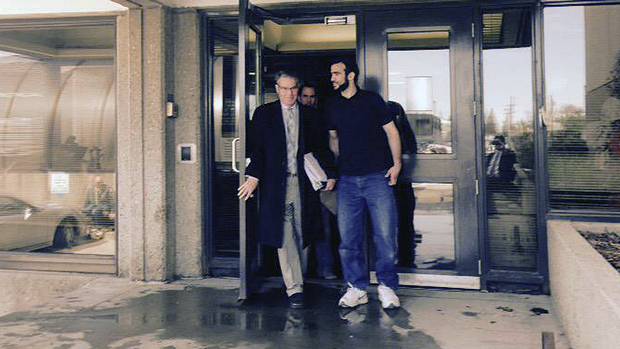
Omar Khadr walks free (photo via his attorney Dennis Edney)
Reactions to Omar’s release
Albert Melise who had once guarded Khadr said news of his release was, “awesome, and very sad he had to go through this.” I asked “what do you remember of him?”… Melise replied,
“I remember him from Camp Delta, and how we escorted him to his interviews aka interrogation sessions. He was just a young adolescent at the time. He was scared and he was cool to talk to. I also seen his brother there but he wasn’t a real detainee aka prisoner. He was recruited to work for an agency I forget which one. I was later transferred to another camp, Camp Echo where I was David Hicks and Moazzam Begg’s guard. Camp Echo is where I remained, until my tenure aka tour of duty ended.”
Stephen Blaney (Member of Canadian parliament) tweeted
“1/2 We regret that a convicted terrorist has been allowed back into Canadian society without having served his full sentence”
“2/2 We are disappointed with the decision. Our Thoughts and prayers are with the family of Sgt Christopher Speer during this difficult time”
Naureen Shah from Amnesty International USA’s Security and Human Rights Program released a press statement on Khadr stating,
“Khadr’s tragic story underscores why Guantanamo should close. Every remaining detainee should be treated as an individual, rather than a symbol or political football. Everyone at Guantanamo must either be charged and fairly tried or released.”
The Free Omar Khadr Now group issued a statement saying,
“today the Free Omar Khadr Now group celebrates Omar’s victory along with all those who struggle for human rights.
We wish to acknowledge the perserverance, diligence and brilliance of his lawyers, Nate Whitling and Dennis Edney.
We extend our deepest respect to Omar Khadr for the dignity and strength he has maintained throughout the years of this horrendous ordeal.”
Links
“Former Guantanamo prisoner Omar Khadr says he is ready for freedom all decent people must agree”
Former Guantánamo Prisoner Omar Khadr Says He Is “Ready” for Freedom; All Decent People Must Agree
Carol Anne Grayson is an independent writer/researcher on global health/human rights/WOT and is Executive Producer of the Oscar nominated, Incident in New Baghdad. She is a Registered Mental Nurse with a Masters in Gender Culture and Development. Carol was awarded the ESRC, Michael Young Prize for Research 2009, and the COTT ‘Action = Life’ Human Rights Award’ for “upholding truth and justice”. She is also a survivor of US “collateral damage”.

 Carol Anne Grayson (Radical Sister) blog