
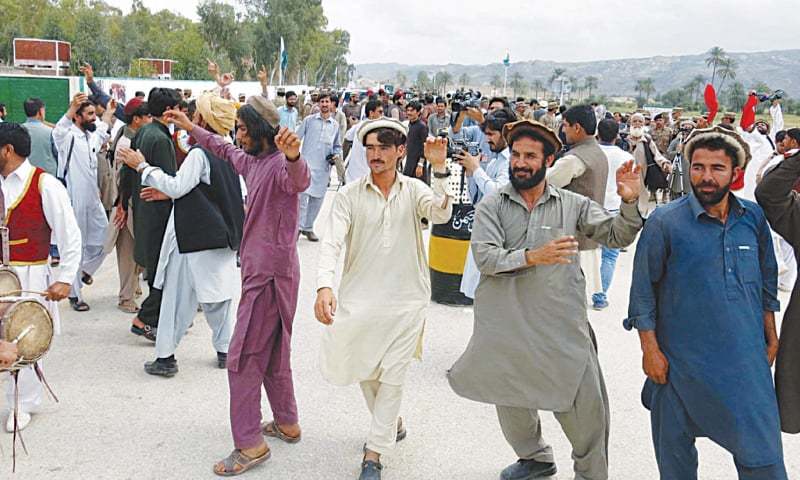
BANNU: Internally displaced people dance at the Kajuri Checkpost to celebrate their return to their homes here on Tuesday.—INP (via Dawn)
Media reports are starting to document the return of Internally Displaced Persons (IDPs) in Pakistan back to North Waziristan. Many locals were abruptly ousted in June 2014 so that the army could begin military operation Zarb -e-Asb against militants in the region. This operation was helped to fruition by CIA chief John Brennan who flew to Pakistan back in February 2014 to meet Gen Raheel Sharif to discuss what NDTV reported as “highly sensitive issues of mutual interest”. This was at a time when the US was highlighting that any future financial aid would be more and more results based. In other words if there was no significant action targeting insurgent groups there may be restrictions on the relied upon millions of dollars received in regular cash injections.
Although IDPs are wanting to return home (albeit with reservations) any initial jubilation will no doubt soon be quashed as reality takes over on viewing the scenes of devastation. To what are they returning?
This week, World Bulletin reports that a few journalists were given an army escorted tour to North Waziristan to see the damage for themselves. Resettlement of IDPs will be staggered in phases. What is in no doubt from those that have surveyed the region, is the severe impact on the infrastructure. Homes, businesses, electricity, water facilities, transport, schools, health clinics (limited though they may have been in the first place) have come under attack and much of the area lies in ruins.
What returning locals will receive as a resettlement package cannot be termed as “compensation for damages” caused by the actions of the Armed Forces. If IDPs were to receive proper compensation, it would be calculated on a number of factors. Firstly they would be compensated for loss of life, injury, mental distress during transition, loss of home (property) and destroyed land, every household or farm item lost or damaged, loss of earnings, business, child’s education and loss of animals. Let’s look at what would you normally be routine preparation for Eid ul Adha asan example. Livestock is usually fed and fattened up for sale for Qurbani. How can locals afford to restock on the goats and sheep many had to leave behind unattended and feed any new animals ready for market though they may have basic food rations for themselves?
The amount of money/income lost even in impoverished areas if calculated fairly could run into tens of thousands of dollars as each family member has been affected in some way, perhaps hundreds of thousands for any large landowners and businesses in the region. Of course this will never happen unless some brave soul tries to litigate against the state and in a conflict situation the chances of winning would no doubt be very slim.
So what help will people actually receive? World Bulletin states that according to Miranshah resident, Mujtaba Dawar, who once owned a local business,
“the government is providing merely 35,000 rupees ($350) to each family for reconstruction of their homes, this amount is not even enough for minor repairs”

Will aid levels be sufficient for returning IDPs?
(Image, “Help the IDPs of FATA”)
Shahid Ilyas writing in the Daily Times states,
“according to reports appearing in the media from time to time, each IDP family will get Rs 200,000 ($ 2,000) for his/her partially damaged home and Rs 400,000 ($ 4,000) for homes that have been destroyed completely.”
However he also points out,
“tribesmen, despite the lack of economic opportunities and income, are used to living in spacious homes. Each family has a member living in the Middle East. Many of them have built large concrete mansions with the money sent home, mansions worth tens of millions of rupees. Imagine: $ 2,000 or $ 4,000 is just not sufficient for even small repairs to their homes. Therefore, most of the tribes from Waziristan consider this move by the government to be a slight.”
Although returning families are to be issued with a SIM card, Rs10,000 for transport expenses, Rs25,000 per household for other expenses and bank ATM cards, DAWN media states, “many families are yet to receive the promised money despite the issuance of ATM cards.” According to the Daily Times, there is some support from Gujranwala Corps who are reported to be supplying a convoy of 6 trucks to supply tents and household items to IDPs starting again. There may also be some assistance from UNICEF in the form of hygiene kits to families and the World Food Programme will provide six months of ration while some agencies will provide vaccinations.
Express Tribune reports,
“the FATA Return and Rehabilitation Strategy has divided development of the tribal areas into three phases; rehabilitation and recovery, which will take about 24 months; medium-term development, to take two to five years; and long-term development, which will take five years and more.
Official records put the current estimated damage in all seven agencies of Fata at over $44.03 million; an additional $320 million is required for reconstruction of damaged houses.”

Soldiers stand guard at a destroyed empty bazaar during a military operation against Taliban militants in the main town of Miramshah in North Waziristan on July 9, 2014.— Photo by AFP
Another question on the cards is whether North Waziristan is about to enter a period of what Naomi Klein (social activist and author) termed “shock doctrine” US “free market” exploitation of disaster shocked people and countries? Will we now see Pakistani and foreign firms competing for lucrative construction contracts? Contracts are unlikely to be awarded to locals from Waziristan as little is left of their businesses so they will be unable to compete and benefit financially themselves from reconstruction.
We know America has agreed to assist Pakistan with financial aid to help rebuild the region. The BBC reported back in 2004 following the devastation after invasion of Iraq that, “the US Defense Department has awarded seven Iraq reconstruction contracts worth a total of about $130m (£72.3m) to consortia of US firms.” (Any countries that opposed the war in Iraq were not allowed to bid.) Although the funding to Waziristan would not be anywhere near that scale, the impact on the region would still be significant. This is going to be a challenging time. An opportunity to improve the region would need to be balanced against any negative impact that might destroy traditional culture and inflict perhaps an unwanted strong western influence while others profit.
How much say will locals have on what is built in their name? Also there is plenty of potential for corruption as has been seen in other war torn or disaster hit regions. We can see from media reports on arrests and court cases it is already happening with some projects in Pakistan. Only yesterday DAWN media reported the following,
“PESHAWAR: The National Accountability Bureau (NAB), Khyber Pakhtunkhwa on Friday arrested Additional Secretary Home & Tribal Affairs Department Arshad Khan and two other officials in a case of embezzlement of compensation funds designated for Internally Displaced Persons (IDPs).
Khan held the position of Director General (DG) Fata Disaster Management Authority at the time when he, in connivance with two others, allegedly embezzled Rs50 million of compensation payment meant for the affectees of the military operations against militants in Mohmand Agency.”
To add insult to injury, accusations against Khan include setting up bogus profiles of IDPs to withdraw money from banks and making fake smart cards. This case highlights the vulnerability of displaced persons that can be easily exploited.
IDPs returning to North Waziristan are also now expected to sign an agreement that will involve helping to maintain peace and security in the region as an individual and collective responsibility whilst the government for their part will initiate development activities. Quite how locals will keep their part of the agreement is unclear and there is controversy arising over this issue.
At present it is difficult to assess whether the military operation and displacement of so many has been worth it. There have been conflicting reports on numbers of insurgents killed depending on who is interviewed and the decision to withhold names of insurgents killed. Misinformation giving false reports regarding militant deaths have led to confusion and a growing lack of trust. Will militancy return? The children of insurgents that were “martyred” are already being prepared in training camps as recent videos show.Only time will tell if operations are deemed successful or not by those affected the most, the IDPs themselves.
The people of Waziristan have for decades been treated as second class citizens within Pakistan, oppressed under Frontier Crimes Regulations (FCR) “black law” left over from British colonialism which has affected their development and human rights. Will any of that change? The return of IDPs is now underway…. locals are going home… but at what cost?
Carol Anne Grayson is an independent writer/researcher on global health/human rights and is Executive Producer of the Oscar nominated, Incident in New Baghdad . She is a Registered Mental Nurse with a Masters in Gender Culture and Development. Carol was awarded the ESRC, Michael Young Prize for Research 2009, and the COTT ‘Action = Life’ Human Rights Award’ for “upholding truth and justice”. She is also a survivor of US “collateral damage”.

 Carol Anne Grayson (Radical Sister) blog
lovely one
Thanks, I worry so much what could happen to IDPs, I want to alert them to wider picture of exploitation “shock doctrine” so they can be aware for their own wellbeing!
Yes Exactly , you did a remarkable job , thumbs up , carry on
Really heart touching article you wrote reality
Thanks, appreciated. A very important issue and I fear worse times ahead for IDPs