
Guest blog with kind permission article originally published by
A Jurists War
The Syria / Iraq conflict has witnessed several armed groups that are operational against President Bashar al-Assad. In the midst of the Syrian conflict, the armed groups consist of paramilitary troops, armed civilians, and deserted/defected soldiers from the Syrian army. Primarily, modest factions emerged from local Sunni Muslims in the region, however with external state influences backing both Shi’i and Sunni sides of the conflict, the formations of the factions have become a network of units. The influx of foreign fighters originating from Europe, Middle East and North Africa has caused international and domestic security concerns, as many of the armed groups on the ground have now been designated as terrorist organisations by the US and others. This note will focus on the armed groups that foreign fighters are joining, so as to provide context and background to the conflict mapping.
Note: It is beyond the scope of this piece to provide a detailed analysis of the groups, as it is appreciated that armed groups have developed throughout the course of the conflict, and a cursory briefing will not provide sufficient depth to necessitate the reality on the ground.
Primary Rebel Coalition
Free Syrian Army (FSA)
The Free Syrian Army consists of soldiers that have deserted their positions, or defected. The establishment in 2011 was effectively a brand name, in which other smaller and autonomous non-state actors started to employ. The FSA did not have any effective control or command structure of other scattered autonomous group. The FSA have been classed as secular in their outlook in comparison to other fighting forces, such as those affiliated with al-Qaeda.
The Islamic Front
The Islamic Front consists of seven armed groups that have joined together in view of creating an independent political, military and social formation. As a consequence, there are approximately 55,000 fighters under this banner. Groups as follows have joined: Harakat Ahrar al-Sham al-Islamiyyah, Jaysh al-islam, Suqour al-Sham, Liwa al-Tawhid, Liwa al-Haqq, Ansar al-Sham and The Kurdish Islamic Front. The aims and objective of the coalition is to remove President Assad and his regime, and create an Islamic state. The Islamic Front does not affiliate with al-Qaeda. The Islamic Front has accepted foreign fighters in their groups, in view of pursuing the objectives, although currently this is an exception rather than a rule.
Islamic State of Iraq and the Shaam (ISIS)
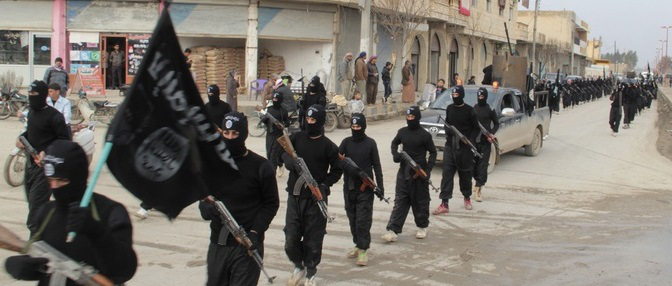
The Islamic State of Iraq and the Shaam (ISIS) is a Sunni group that seeks to establish an Islamic state, governing by Islamic jurisprudence across Syria and Iraq. The group originated from Iraq, as a consequence of the US led invasion to remove Saddam Hussein. It was branded as al-Qaeda in Iraq (AQI) and was headed by Abu Musab al-Zarqawi in 2003. When a US air-strike killed al-Zarqawi in 2006, Abu Ayyub al-Masri – an Egyptian explosives expert with links to al-Zawahiri was given leadership of the non-state actor. However, with an appeal needed to employ local support and territorial objectives in Iraq, al-Masri adopted a new brand, called the Islamic State of Iraq (ISI).
Al-Qaeda had a deep interest in the Syrian conflict in 2011, and consequently directed its affiliate in Iraq, Islamic State of Iraq (ISI) to assist in the creation of Jabhat al-Nusrah (JN).
In 2012, the ISI re-branded itself as Islamic State of Iraq and the Levant (ISIL) – alternatively known as The Islamic State of Iraq and Shaam (ISIS). This was due to a more transnational objective by the non-state actor, so as to extend their efforts and objectives, as fighters had already spilled over into Syria, in the wake of the uprisings in 2011.
In April 2013, Abu Bakr al-Baghdadi, the leader of ISI claimed a merger with al-Nusrah, intending to unite the Iraqi and Syrian factions creating Islamic State of Iraq and Shaam (ISIS).
ISIS has conducted numerous operations, including suicide operations that resulted in the capture of military bases. ISIS has 3000-8000 fighters, and it is believed that this number is growing with a sustainable influx of foreign fighters. ISIS’ relationship with other non-state actors has effectively placed them in a position of internal conflict between groups. ISIS is operational across Syria, and has gained substantial effective control of Iraq’s territory, including Ramadi, Falluja, and Mosul in June 2014.
ISIS have overtaken considerable territory in Iraq, with assistance from the local Sunni groups that have joined the ranks of ISIS, including The Islamic Army in Iraq – in view to alleviate the grievances the Sunni’s have with the al-Maliki government in relation to the disparity of national policies and governance between the Sunni and Shi’i populations for the past 10 years. Consequently, the local Sunni population view ISIS in a completely different lens, as opposed to ISIS’ activities in Syria – however this view may have changed. Although President Obama may pursue ISIS with use of force, the president has also reinforced the notion that ultimately a political change must occur in leadership by stating, “[a]bove all, Iraqi leaders must rise above their differences and come together around a political plan for Iraq’s future. Shia, Sunni, Kurds — all Iraqi’s — must have confidence that they can advance their interests and aspirations through the political process rather than through violence”. This social-political tension is one of the rationales that ISIS wanted to address, and therefore they are receiving assistance from other factions from within Iraq. ISIS operates independently, and does not have any connection to al-Qaeda – the implications of this severed connection will be inferred upon in a separate blog note.
In June 2014, ISIS rebranded itself as the Islamic State (IS) as it claimed it had declared a Caliphate, with Abu Bakr al-Baghdadi as the Caliph. An official document was released, citing the Islamic objectives and rationales for the Caliphate, calling upon Muslims to join the ranks of Islamic State (IS), formerly known as The Islamic State of Iraq and Shaam (ISIS). This is an unprecedented move by any armed group on modern conflicts around the globe, and has trigger great tensions between other groups that are fighting in Syria, Iraq and other realms of conflict. The Islamic State does not recognise the colonial Sykes Picot agreement, and intends to expand its territorial gain beyond Iraq and Syria.
Jabhat al-Nusrah (Support Front)
Jabhat al-Nusrah (JN) – a group with approximately 7000 –to- 10000 fighters, was essentially assisted by ISIS. The United States (U.S) designated al-Nusrah a terrorist organisation , in which triggers a plethora of legal, political and military consequences that will be analysed later. However, there was a turning point in the formation of the group in 2013, as the leader of al-Nusrah, Abu Mohammad al-Julani, rejected a merger with ISIS due to political and strategic reason. There are also reports that the merger did not occur due to claims of brutality by ISIS in Syria. This triggered internal conflict between the al-Nusrah and ISIS, and thus operated as separate armed groups or entities on the ground. Ayman al-Zawahiri, the leader of al-Qaeda, attempted reconciliation between the two groups and urged them to stay located within their country of origin, however ISIS refused, as this would reinforce a colonial border. Consequently, ISIS and JN operate independently in Syria, conducting military objectives, and providing aid and social assistance to the Syrian people. Foreign fighters assisting in the armed struggle against President Assad have joined both groups.
Of key importance is understanding that JN attracts a great deal of membership from foreign fighters, and that while the foreign fighters have their own distinct group, they are all under the direct leadership of a Syrian. Despite media representations, of particular surprise is the amount of support JN receives among the local population. Unlike ISIS, JN appears to also have gained the respect and trust of the other fighting groups, particularly those under the general banner of the Islamic Front.
Unlike the traditional methodology of al-Qaeda Central (AQC), that concentrated its objectives on the ‘far enemy’, the approach taken by JN seems to be far more in line with a traditional internal armed conflict, concentrating their attacks directly at pro-Assad forces and military objectives.
Other Anti-Assad Groups
There are hundreds of groups fighting on the ground in Syria, majority of them cooperate with each other, although this relationship differs across locations.
Jaysh al-Muhajirin wa-al-Ansar (Army of the Emigrants and Helpers)
This non-state actor consists of hundreds of fighters, majority of them being foreign fighters, located in Aleppo. The leader is Abu Omar al-Shishani, a veteran Chechen fighter, and under his command, the non-state actor has affiliated with ISIS.
Jund al-Shaam (Soldiers of the Levant)
Jund al-Shaam is a smaller non-state actor, operating highly independently in the conflict. Majority of the soldiers originate from Northern Lebanon, and work alongside other networks, particularly in Homs.
Several other factions exist, such as Fatah al-Sham; the Abdullah Azzam Brigades (AAB); Turkiye Halk Kurtulus Partisi-Cephesi (THKP-C); Kateeba al-Kawthar (KAK); and the Popular Front for the Liberation of Palestine-General Command (PFLP-GC). The British government has proscribed these groups as international terrorist organisations, and included them in the proscribed groups under Schedule 2 of the Terrorism Act 2000.
[END]
Carol Anne Grayson is an independent writer/researcher on global health/human rights/WOT and is Executive Producer of the Oscar nominated, Incident in New Baghdad . She is a Registered Mental Nurse with a Masters in Gender Culture and Development. Carol was awarded the ESRC, Michael Young Prize for Research 2009, and the COTT ‘Action = Life’ Human Rights Award’ for “upholding truth and justice”. She is also a survivor of US “collateral damage”.

 Carol Anne Grayson (Radical Sister) blog