
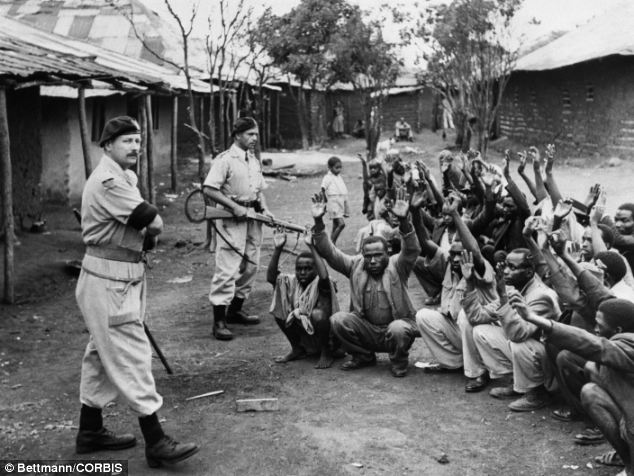
Uprising: British police Guarding Mau Mau suspects in Kariobangi, Kenya (image Bettman/Corbis)
A chance encounter with a Kenyan asylum seeker at a human rights conference provided me with a history lesson more valuable than many I had learned at school. George Mwangi was fighting his legal case to remain in the UK after being tortured in his own country and we were both actively campaigning to highlight the physical and psychological abuse of asylum seekers within UK detention centres through an organisation called Barbed Wire Britain. During our many conversations he used to joke that I reminded him of his grandmother in my determination to fight for justice. He explained that she was a Mau Mau (militant African nationalist movement that originated in the 1950s among the Kikuyu people of Kenya) that were detained by the British during colonial rule.
I had vaguely heard of the Mau Mau, a name I knew was associated with some fear and trepidation by an older generation of Britons but was eager to learn more. Fred Majdalany’s history, State of Emergency, The Full Story of Mau Mau, claims that the name originates from an anagram of Uma Uma (which means “get out, get out”) and was a military codeword based on a secret language-game Kikuyu boys used to play at the time of their circumcision. He states also that to the British it was simply a term given to the ethic group of Kikuyu’s without specific definition.
Over time my friend related stories of the pain and suffering of the grandmother that he loved and admired so much during her incarceration at the hands of the British. In order to help me understand the level of oppression and the importance of “throwing off the colonial burdon” George introduced me to the work of Kenyan writer, Ngugi wa Thiong, author of Decolonising The Mind. The book explained the relevance of exploring the reasoning behind reverting from writing in English (the language of the colonizer) to a return to the language of Kikuyu (or Gikuyu as it is sometimes called). To further advance my education he also presented me with the works of Professor Caroline Elkin, Imperial Reckoning along with Britain’s Gulag: The Brutal End of Empire in Kenya and I was faced once again with the fact that the history lessons I had learnt at school often either omitted some key periods entirely or provided pupils with only a sanitized version of events.
Elkin herself states, “when I presented my dissertation proposal to my department in the winter of 1997, I was intending to write a history of the success of Britain’s civilising mission in the detention camps of Kenya” what she discovered however was that there were mystifying gaps in records that had otherwise been meticulously kept which aroused her curiosity. Documents detailing actions of the British had been flown out of Kenya on the eve of Independence some of which are still labelled as “classified” 50 years after the war with Mau Mau. This prompted Elkin to delve deeper on a fact finding mission and her journey of discovery can be followed in a YouTube lecture…Colonial War Crimes in Kenya http://www.youtube.com/watch?v=G5AdhsXN-uo
In recent years, four Kenyans that were allegedly been tortured took legal cases against the British for their treatment during the Mau Mau uprising and one of the Empire’s bloodiest conflicts. It opened doors that had been shut for decades. Russia Today reported that “in 2010, UK legal firm Leigh Day successfully sued the British government on behalf of Kenyans who rebelled against UK colonial rule in the 1950s. The UK government paid £19.9m to 5,228 Kenyans in 2013 who were reportedly tortured by Britain’s colonial administration during the revolt.” However another 40,000 cases are currently being filed in a second wave of litigation that will include seeking justice for alleged forced removal, detention, systematic torture and serious sexual assault.
Since 1945, nationalist Jomo Kenyatta of the Kenyan African Union had challenged the British over the redistribution of land to white settlers which had left many Kenyans economically marginalised within their own country. Mau Mau swore an oath of allegiance to resist this oppression and took action by raiding farms, killing livestock and also through political opposition. The response by the British was to introduce a state of emergency in 1952 and thus began a brutal clampdown using systematic violence that included “search and destroy” missions and those suspected of insurgency were often detained for years without trial. The BBC reports Martin Day (human rights lawyer for the Mau Mau) as saying, “they were put in camps, where they were subject to severe torture, malnutrition and beatings. The women were sexually assaulted, two of the men were castrated, the most brutal torture you could imagine.” The British also used the African Home Guard which included African troops from Uganda and Tanganyika to quash rebellions in feared night time raids on Kikuyu villages.
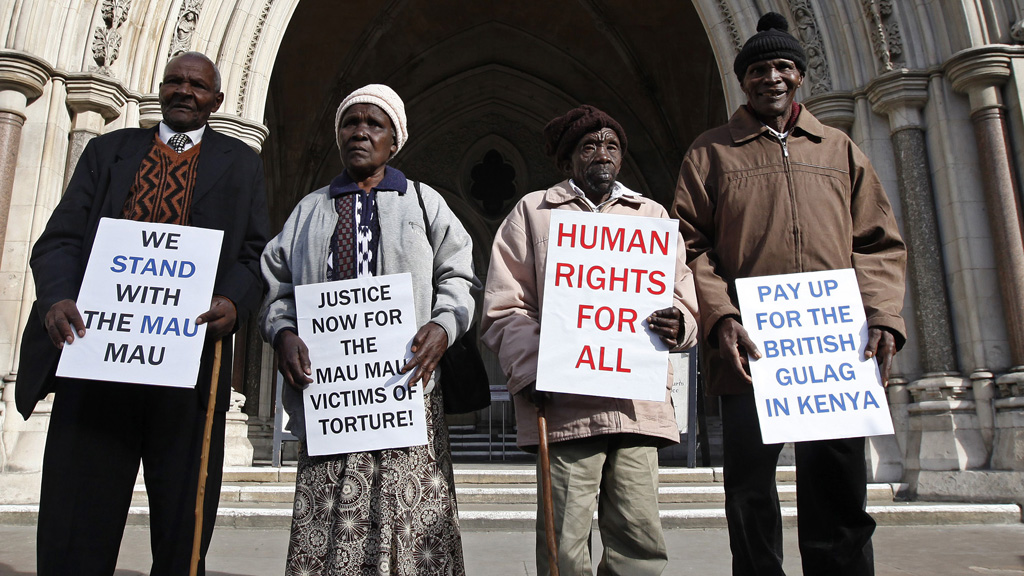
Campaigners for Mau Mau (Channel 4)
The Daily Mail highlights several cases, one of those is Wambugu Wa Niyingi who claims to have been suspended by his feet from a hut roof, “he was then subjected to a severe beating over 30 minutes, while cold water was poured on his face and into his mouth so he could not breathe.” One woman alleges sexual assault with bottles filled with hot water and others are suing for compensation for castration. The paper also claim’s President Obama’s grandfather was among those abused. It is alleged he was detained for two years in 1949, regularly whipped and that according to his third wife Sarah Onyango, “white jailors would squeeze his testicles with parallel metallic rods and pierce his nails and buttocks with pins.”
Further cases of horrific brutality were detailed in the Independent as follows,
“A woman, now 76, who details how, as a 14-year-old girl she and her family were brutalised during a raid by colonial police before two white soldiers forced her to have sex with her own father while they looked on.
A man, now aged 79, who describes how he was placed above a metal drum of burning charcoal, known as the “hat of death”, and beaten until he defecated over himself, before then being beaten unconscious with a hammer.
Another man, now 83, who suffered regular torture including a punishment which involved being made to dig a hole with his index finger by constantly turning his crouched body in a circle, causing dizziness punished by further beatings.”
There was violence on both sides of the conflict however in terms of figures there were 1090 Mau Mau hanged by the British compared to the killings of 30 white settlers during the 8 years of emergency and at least 11,000 Mau Mau were killed during counter-insurgency operations through the true figure may well be far higher.
The British government in its efforts to avoid the possibility of high compensation bills for a long time denied any culpability arguing that it is the Kenyan government that must shoulder responsibility since liability was handed over with Independence. Through my own personal experience of my husband litigating against the British government (haemophilia contaminated blood cases which included human rights abuses and complicity in torture through unethical experimentation), I know only too well the level to which the British government will go to hide wrongdoing and that destroying documents, hiding evidence, lying and failing to accept responsibility for harm and death is common to this very day. It is my hope that ALL the cases of Kenyans who suffered so terribly during Colonial rule will find justice through British courts. However I fear that like us they will face government resistance, time limits and years of delays through a flawed legal system. In the event of strong evidence to support their case they will likely be met with the offer of a pathetic “out of court” settlement (with a possible “silence” clause) which will not reflect their level of distress, loss and continued suffering. I hope I am proven wrong.
For years now Brits have witnessed the hypocrisy of western “democracy”…that we live in a society where government criticises the human rights of other countries whilst violating the human rights of its own citizens…a society where greed is often placed before ethics and morality and exploitation of others continues to be firmly entrenched in our foreign policy. Justice is not only about compensation, what many victims of injustice seek most of all is to be believed, the truth to be told, apologies to be given and for systems to change.
Foreign Secretary, William Hague, expressed regret for the first time on 6th June 2013 in the House of Commons, that thousands of Kenyans had been subjected to torture and other forms of ill-treatment at the hands of the British colonial administration during the Kenya Emergency of the 1950’s. However, there are still 40,000 people whose cases have still to be heard, they are old now and time is not on their side.
My own feeling is that although Britain gave up its colonies, successive British governments have retained something of a colonial mentality and former colonies have not entirely released their own minds from enslavement. In other words the abuse continues. There are lessons still to be learnt from the Kenyan experience, British oppression continued years later through the occupation of Iraq and Afghanistan. The subject of abuse by the state has not gone away, allegations remain regarding the outsourcing of torture and the treatment of those caught up in the so called “war on terror”.
Britain still hangs on to the remnants of imperial thinking and is not hearing foreign voices that are saying, they don’t want loans and handouts, stop arming dictators…that they want to develop their own system of government with people of their choosing and stand on their own two feet. Government needs to examine British foreign policy and concerns raised regarding the alleged role of our security services in radicalizing young people at home and further afield. We have MI6 chief, Sir John Sawers (who has recently stepped down) acting like an apologist, stating that torturing terror suspects produces “useful information.” The definition of “who is a terrorist can be very misleading” and innocents get caught up in government clampdowns. If we reflect back, many Kenyans were treated as inferior, often wrongly labelled as terrorists, placed in gulags and tortured… we need to learn lessons from the past.
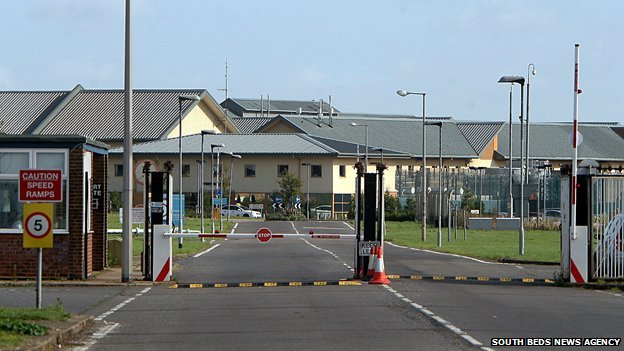
Modern day detention in Yarls Wood, UK but with some old colonial attitudes to detainees (image South Beds News Agency)
I feel it is fitting to end this article with reference to a letter sent from the grandson of a Mau Mau, my old campaigning friend George http://www.aworldtowin.net/frontline/asylumseekeropenletter.html In a sense he summed up many of the failings of Britain (which continue today) in an open letter he addressed to Tony Blair in 2007 Your British Values Are Alien To Our Human Values. This time the protest was not about detention by the British in Kenya but detention and abuse suffered within UK detention centres of a not so “Great” Britain! This week our country is once again shamed by allegations on Channel Four regarding treatment of asylum seekers particularly women in Yarls Wood and alleged abuse. Sad to say the racist language, white supremacist attitude and degrading of detainees appeared horribly reminiscent of colonialist behaviour in the detention camps of 1950s Kenya…and made me think of George’s grandmother, not a good advert for modern day Britain!
Links
40,000 Kenyans accuse Britain of abuse in second Mau Mau law suit
http://rt.com/uk/200487-kenyans-sue-uk-government/
Mau Mau uprising: Kenyans still waiting for justice join class action over Britain’s role in the emergency
Carol Anne Grayson is an independent writer/researcher on global health/human rights/WOT and is Executive Producer of the Oscar nominated, Incident in New Baghdad . She is a Registered Mental Nurse with a Masters in Gender Culture and Development. Carol was awarded the ESRC, Michael Young Prize for Research 2009, and the COTT ‘Action = Life’ Human Rights Award’ for “upholding truth and justice”. She is also a survivor of US “collateral damage”.

 Carol Anne Grayson (Radical Sister) blog