
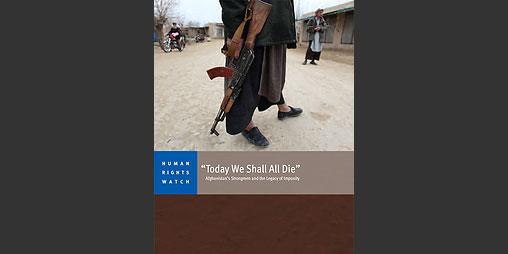
Human Rights Watch has released an important new report on Afghanistan entitled, “Today We Shall All Die: Afghanistan’s Strongmen and the Legacy of Impunity.” The 96 page document details the profiles of eight “strongmen” linked to police, intelligence, and militia forces responsible for serious abuses in recent years. (This particular report excludes any alleged human rights abuses by the Taliban which can be found in other HRW publications.) HRW explores institutionalized violence and highlights the fact that victims of human rights violations have been unable to obtain justice with a reluctance to hold key figures to account. This brings into question the role of the Afghan government and the US that has helped train and develop organizations carrying out extreme brutality throughout Afghanistan. These include the Afghan National Police units, National Directorate of Security officials, and Afghan Local Police forces.
Extract from report,
“This report is about some of the people who carry out serious human rights violations yet enjoy impunity. The accounts in this report include allegations of mass killings, murder, rape, torture, beatings, enforced disappearances, theft, and arbitrary detention. The perpetrators of these abuses are persons in positions of authority or persons who operate with their backing. We have chosen examples that illustrate that they occupy positions in almost every level of government, from local militia commanders to ministerial rank; victims and perpetrators come from each of the major ethnic communities in Afghanistan. While the perpetrators are not representative of the Afghan security forces as a whole, their actions have an impact in Afghanistan that extends beyond the immediate victims, as they degrade the commitments to human rights, justice, and the rule of law that Afghanistan has made in its constitution and international treaties.”
“Profiles of Impunity” covered in the report are named below,
Abdul Hakim Shujoyi
Khair Mohammad Timur (“Cherik”)
Commander Azizullah
Atta Mohammad Noor
Haji Najibullah Kapisa
Mir Alam
Asadullah Khalid
Abdul Razik
The report follows closely on the heels of the United Nations Assistance Mission in Afghanistan (UNAMA) report, “Update on the Treatment of Conflict-Related Detainees in Afghan Custody: Accountability and Implementation of Presidential Decree 129″. This publication explored cases of torture and degrading treatment of those in custody. UNAMA identified that 790 detainees were interviewed from February 2013 to December 2014 with 35% indicating torture or ill-treatment during incarceration, some 278 cases, this included 105 children of whom 44 were said to have experienced ill-treatment. This report can be found on the following link,
Press Release from HRW on new report,
Afghanistan Abusive Strongmen Escape Justice
Donors Should Press New Government on Prosecutions
March 3rd, 2015
(Washington, DC) – Afghanistan’s new government should prosecute officials and commanders whose serious human rights abuses have long gone unpunished, Human Rights Watch said in a report released today. US officials should press President Ashraf Ghani to take up justice for past abuses as a top priority during Ghani’s expected March 2015 visit to Washington, DC.
“The previous Afghan government and the United States enabled powerful and abusive individuals and their forces to commit atrocities for too long without being held to account,” said Phelim Kine, deputy Asia director. “The Ghani administration has already taken the welcome step of launching a national action plan to eliminate torture. The United States, which helped install numerous warlords and strongmen after the overthrow of the Taliban, should now lead an international effort to support the new government to remove serious human rights abusers from their ranks.”
The 96-page report, “‘Today We Shall All Die’: Afghanistan’s Strongmen and the Legacy of Impunity,” profiles eight “strongmen” linked to police, intelligence, and militia forces responsible for serious abuses in recent years. The report documents emblematic incidents that reflect longstanding patterns of violence for which victims obtained no official redress. The impunity enjoyed by powerful figures raises serious concerns about Afghan government and international efforts to arm, train, vet, and hold accountable Afghan National Police units, National Directorate of Security officials, and Afghan Local Police forces.
The government of former president Hamid Karzai failed to bring these individuals and their forces to justice, fostering further abuses and fueling local grievances that have generated support for the Taliban and other anti-government forces. Ghani has pledged to hold security forces accountable for their actions and end official tolerance for torture, but will need the full support of Afghanistan’s international supporters to carry out this politically sensitive task.
The report is based on 125 interviews Human Rights Watch carried out since August 2012 with victims of abuse and their family members, as well as witnesses, government officials, community elders, journalists, rights activists, United Nations officials, and members of Afghan and international security forces. It does not look at abuses by the Taliban and other opposition forces, which Human Rights Watch has addressed in other contexts.
A resident of Kunduz province whose father was murdered by a local militia in 2012 told Human Rights Watch, “I went on the roof of the house and saw we were surrounded by armed men…. My father was sitting there and said: ‘Say your whole kalima [the Muslim profession of faith], because I think today we shall all die.’”
Officials and commanders whose forces have a history of abuses typically go unpunished. For instance, forces under the command of Hakim Shujoyi have killed dozens of civilians in Uruzgan province, yet despite a warrant for his arrest he remains at large and evidence suggests he has enjoyed the support of US forces. In Paktika province, Afghan Local Police forces under the command of Azizullah,an ethnic Tajik who, as of June 2014, was a commander of the local ALP in Urgun district, have committed multiple kidnappings and killings. Azizullah has worked closely with US Special Forces despite their awareness of his reputation for unlawful brutality.
The provincial chief of police in Kandahar, Brig. Gen. Abdul Raziq, has been directly implicated in ordering extrajudicial executions. And when the former head of the National Directorate of Security Asadullah Khalid sought medical care in the United States, he received a personal visit from President Barack Obama, sending a powerful message of US support for a notorious human rights violator.
“Since the defeat of the Taliban government in late 2001, Afghanistan has made limited progress in developing institutions, such as professional law enforcement and courts, that are crucial for the protection of human rights,” Kine said. “Afghanistan’s international allies have exacerbated the problem by prioritizing short-term alliances with bad actors over long-term reforms. It’s time for this pathology to end.”
Human Rights Watch urged the Afghan government to investigate all allegations of abuse by Afghan security forces, and remove from office and appropriately prosecute officials and commanders implicated in serious abuses. The Ministry of Interior should disband irregular armed groups and hold them accountable for abuses they have committed.
The United States and other major donors to the Afghan security forces should link continued funding to improved accountability, including prosecutions for killings, enforced disappearances, and torture. Donors should ensure that direct assistance to Afghan security forces is benchmarked to improvements in justice mechanisms. The US should fully implement the Leahy Law, which prohibits the provision of military assistance to any unit of foreign security forces where there is credible evidence that the unit has committed gross violations of human rights and that no “effective measures” are being taken to bring those responsible to justice.
“The Afghan government and its supporters should recognize that insecurity comes not only from the insurgency, but from corrupt and unaccountable forces having official backing,” Kine said. “Kabul and its foreign supporters need to end their toxic codependency on strongmen to give Afghanistan reasonable hope of a viable, rights-respecting strategy for the country’s development.”
Full report can be read on link below,
Today We Shall All Die: Afghanistan’s Strongmen and the Legacy of Impunity
Click to access afghanistan0315web_0.pdf
Both the HRW report and the UNAMA report paint a disturbing picture of current human rights violations in Afghanistan. The Islamic Emirate (Afghan Taliban) have for years produced their own reports drawing attention to the abusive actions of key institutions and documented civilian victims in monthly reports. HRW findings illustrate the danger of automatically rejecting Taliban claims as “propaganda” which some individuals and groups have chosen to do, thus colluding with the perpetrators. In addition, media often appear reluctant to “name and shame” those warlords and militias that are current stakeholders in Afghan society wielding power through punishment, this bias must stop.
HRW have raised serious questions and concerns regarding the relationship between Afghan and US governments to named individuals and institutions in the report and to what level they have helped support and sustain these abusive entities. It is essential that international pressure is put on governments to ensure appropriate action will be taken to bring those responsible to account and deliver justice to victims and their families.
Carol Anne Grayson is an independent writer/researcher on global health/human rights/WOT and is Executive Producer of the Oscar nominated, Incident in New Baghdad . She is a Registered Mental Nurse with a Masters in Gender Culture and Development. Carol was awarded the ESRC, Michael Young Prize for Research 2009, and the COTT ‘Action = Life’ Human Rights Award’ for “upholding truth and justice”. She is also a survivor of US “collateral damage”.

 Carol Anne Grayson (Radical Sister) blog