
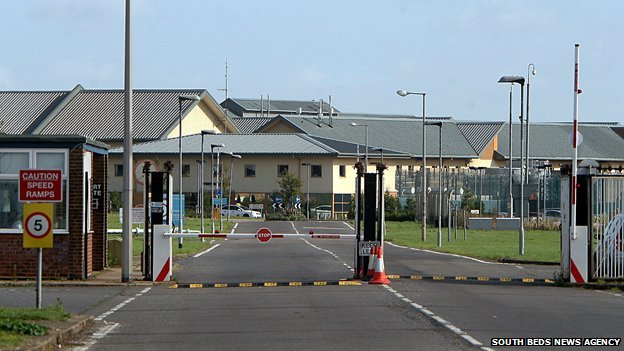
Yarls Wood (image South Beds News Agency)
Introduction
Back in August 2007, I wrote a short report on “Abuse of Asylum seekers in UK detention Centres” as a volunteer with a group named “Barbed Wire Britain”. I was shocked at what I was hearing and aimed to document several cases to draw attention to the plight of those in centres such as Yarls Wood, Colnbrook, Campsfield and Dungavel.
Unfortunately I had no financial resources so was limited as to what I could achieve as there was no funding to travel around the country to visit those in detention. I was reliant on a committed network of like-minded volunteers including some former detainees to get the word out that I was collecting information and evidence and upon letters received from those in detention to share their experiences though they were very fearful of speaking out.
Detailed reports from lawyers such as Gareth Peirce and charity, Medical Justice were able to explore this issue in much greater detail. The Barbed Wire Britain report was however submitted to the Independent Asylum Commission in 2007. Sadly it seems little has changed, the horrific abuse continues.

Protesters outside Yarls Wood angry at alleged abuse of women (image Refusing to kill)
Tonight Monday 2nd March, Channel Four News will screen a report regarding its own investigation into Yarls Wood Detention Centre. An article which went out from Channel 4 on Sunday 1st March stated the following,
“The treatment of detainees inside the notorious Yarl’s Wood immigration removal centre is revealed in exclusive footage obtained by a Channel 4 News investigation.
The Channel 4 News investigation reveals:
Numerous incidents of self-harm
Questions over standards of healthcare
Guards showing contempt for detainees
Yarl’s Wood, which holds nearly 400 detainees, is the UK’s most secretive immigration detention centre. It has been plagued by damning accusations about the behaviour of guards since it opened in 2001.
Cameras have never been allowed inside. Even the United Nations special rapporteur for violence against women was barred entry.
Headbutt the b***h. I’d beat her up. Yarl’s Wood staff
But on Monday evening Channel 4 News will reveal footage shot undercover inside the facility over a period of months.”
See full article here, on a link provided via Medical Justice, an organization that provides medical services, support and training to assist asylum seekers in the UK.
http://www.channel4.com/news/yarls-wood-immigration-removal-detention-centre-investigation
Medical Justice also highlighted the following article by Tom Harper Home Affairs Correspondent in the Sunday Times also published on 1 March 2015,
“AN UNDERCOVER investigation has revealed a culture of racism, sexism and threats of violence in Britain’s most notorious detention centre.
Footage recorded in Yarl’s Wood immigration removal centre reveals that desperate prisoners threw themselves down a staircase in apparent attempts to commit suicide.
In one of the most shocking incidents uncovered by the investigation by Channel 4 News, a bleeding woman suffering a miscarriage had to wait three hours after begging guards to let her see a doctor.
Staff said she was “refusing to wait her turn” and admonished her for ringing an ambulance herself.
Guards were filmed describing various detainees as “black bitch”, “evil”, and one warder even threatened to “get a stick and beat them”.
Yarl’s Wood is operated by Serco, a private company paid hundreds of millions of pounds of taxpayers’ money.”
Full article can be seen on Sunday Times link,
I have also decided to put my 2007 report online again so people can check back to what was happening at that time and compare to the situation today, cases 9 and 10 refer to Yarlswood!
REPORT ON ABUSE OF ASYLUM SEEKERS IN UK DETENTION CENTRES
PAPER SUBMITTED TO THE INDEPENDENT ASYLUM COMMISSION
ON BEHALF OF BARBED WIRE BRITAIN- AUGUST 2007
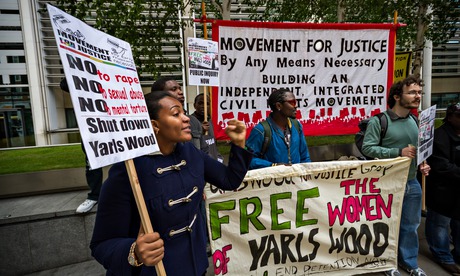
Abuse continues at Yarls Wood despite earlier reports warning of the dangers (image Guardian)
Detention: A Culture Of Abuse
Barbed Wire Britain Network to end Refugee and Migrant Detention (BWB) is an organisation run by volunteers that calls for an immediate end to the inhumane UK government policy of detaining asylum seekers. Those detained are often held for long periods against their will, deprived of information on their human rights, and treated as though convicted criminals within a system that is inherently racist. Many detainees exist in fear trapped in immigration prisons that promote a culture of bullying and intimidation with little opportunity for legal redress.
In 2005 Amnesty International published a report criticising government policy on detaining asylum seekers. UK Director Kate Allen stated that “Seeking asylum is not a crime, it is a right. Thousands of people who have done nothing wrong are being locked up in the UK. We found that in many cases there was no apparent reason to detain people” (Refugee Council, 2005).
The BWB committee includes a number of former detainees that have been “processed” through the detention system and we utilize the wealth of experience shared by those who have suffered under this draconian regime. Steel et al (in Wilson and Drozdek, 2004, p. 659) note that post 9/11 “increasingly a number of Western democratic countries appear to be turning away from their commitment to universal humanitarian principles.” One area where BWB would argue that this has become most marked is in relation to the harsh legislation applied to maintain the subjugation of asylum seekers.
In addition to the general clampdown regarding the basic human rights of refugees and asylum seekers BWB committee members have received information over the past few months on a number of cases of abuse of detainees. Incidents appear to be on the increase alongside an increase in the level of aggression used against those incarcerated. Some of the more recent cases we have encountered are documented within this paper. We call on the Independent Asylum Commission (IAC) to address our concerns as we fear it is only a matter of time before someone else dies in detention either through self-harm or through neglect/maltreatment at the hands of centre staff and those employed as escorts in the removal of “failed” asylum seekers during the deportation process. Medical Justice (MJ) an organisation set up recently to provide independent medical advice to immigration detainees notes that “at least 33 patients seen by MJ doctors fulfilled ICD10 criteria for Post- Traumatic Stress Disorder or depression” (MJ Information Booklet, p.1). To date there have been 12 suicides in detention centres since the beginning of 2000 (Refugee Council Website).
Incidents of abuse have led to repeated hunger strikes and riots by those that have no other means of expressing their distress and anger at their treatment and are desperate to alert the outside world to their plight. Barbed Wire Britain was quick to issue a media release in support of those involved in the most recent uprising at Campsfield immigration prison near Oxford. As Bill MacKeith BWB committee member points out, it appears that this latest incident was triggered by the beating of a detainee as officers attempted to deport a man whose asylum case had not been resolved. The press statement also reminds the reader that “it was the violent removal of an Algerian detainee that triggered the mass revolt at Campsfield in June, 1994” (MacKeith, March 14th, 2007). In an impassioned open letter to Prime Minister Tony Blair published on Indymedia website, George Mwangi, Kenyan human rights activist and former detainee outlines the deplorable conditions for refugees and asylum seekers. He writes:
“Sir, your privately run, profit-making concentration camp guards mentally torture us, they abuse us and threaten us while we fight for our rights, keeping us in isolation to make it difficult for us to defend our rights. You pay the private companies £1,230 a week to profit from our misery (you make free legal representation to fight for our freedom less than this amount), and enriched with tens of millions of your tax payers money to lock us up and abuse us- yet you accuse us for your failures- lying to your gullible population that we are the cause of all your problems, your failures.” (Mwangi, April 27, 2007)
Abuse of detainees is not a new issue. Jamie Doward of the Observer newspaper reported back in May 2004 on the “systematic physical, mental and verbal abuse” of asylum seekers in detention centres. At that time Birnberg Pierce, a London- based solicitors firm representing asylum seekers alerted the paper to the fact that it was receiving a new allegation of abuse each day. In the same article Labour MP Neil Gerrard, chairman of the all-party group on refugees stated that, “What has struck me is the number of similar stories that have kept coming up. They can’t all be false. Things are happening that should not be happening.” The Institute of Race Relations (IRR) also issued a press release in July 2004 which claimed:
“there are growing reports of violent treatment by custody officers at detention centres. In one case, which is currently being investigated, this may also have resulted in a death at Haslar immigration removal centre.”
Despite their very difficult life circumstances Barbed Wire Britain committee members have fought back and not allowed their memories of detention to crush their spirits. George Mwangi and fellow ex-detainee Patrick Ramazani have used their experience to help others in a similar situation and both recently graduated from a human rights advocacy course run by Amnesty International. Patrick offers help and advice to other detainees and as a trained pastor works with asylum seekers attending local churches (Cleary, 2006). George was nominated for a Liberty and Justice human rights award for his “outstanding achievements” in fighting his own case and supporting those that continue to suffer in detention (Liberty Website, 2006). Former detainee Edward Nasho, a qualified lawyer and environmentalist from Zimbabwe works with the local constabulary in Middlesborough to improve communication between asylum seekers and the police. He is in the process of writing a publication to educate those detained on their human rights and speaks at conferences to share his personal experience with fellow lawyers working with asylum seekers. Ex-detainee and trained agronomist Gabriel Nkwelle wrote a series of letters from detention outlining the degrading and dehumanising conditions within centres and prisons holding asylum seekers. He has worked with Bail In Detention (BID) to promote the rights of those incarcerated and his letters can be viewed on the BWB website.
Gabriel uses the power of the pen to fight for abolition of detention. He writes that, “inmates have attempted serious self-harm and nobody cares. Medication is a forgotten issue, if you happen to be sick, the grave should be your next home.” One letter describes an unprovoked attack by a member of staff on a Somalian asylum seeker detained at Belmarsh House block 3. The attack was witnessed by two other staff members. Gabriel states:
“he had tooth ache pains and drew the attention of a member of staff to take him to health care. A member of staff came. Instead of taking the detainee to health care, he moved out his cellmate and butted him and beat his back on the wall, saying “You bloody fucking African. If you are sick go back home.”
Gabriel repeatedly draws attention to the institutional racism within centres noting that staff demonstrate a total lack of respect towards those imprisoned and regularly refer to detainees as “Kunte Kinte” (a reference to the 1970s TV drama series on the enslavement of black Africans within America). He also notes with some irony that a system of slave labour exists where detainees are placed on work assignments/assembly lines for 0.25p an hour. In contrast to this in the outside world many asylum seekers are denied the right to work by the very same government departments that promote slave labour within detention. According to Gabriel, in some centres asylum seekers suffer further humiliation on a daily basis by being made to wear bibs while in the social visits hall and at HMP Rochester were regularly served “out of date” food items. Those who express dissatisfaction with their conditions are threatened with confinement in segregation units.
Asylum seekers and their supporters argue strongly that the current UK system of detention exacerbates any existing physical and mental health problems. Aamer Sultan, medical practitioner (himself a detained asylum seeker) and Kevin O’ Sullivan, clinical psychologist, studied over 50 detained asylum seekers during a 12 month period at Villawood Detention Centre, Sidney. They concluded that “prolonged detention of asylum seekers appears to cause serious psychological damage” and observed that those whose cases failed “experienced stages of increasing depression, punctuated by feelings of protest, as feelings of injustice overwhelm them” (Sultan, O’Sullivan, 2001, p. 593). The findings on abuse in detention are universal. Paris Aristotle, a mental health professional and member of the Immigration Detention Advisory Group reported his own findings in relation to the Woomera Detention Centre in South Australia where there was a history of racial, physical and sexual abuse particularly with regard to women and children. He stated that there was:
A culture of self-harm and the extent to which depression and anxiety are dominant within the population at the detention centre has now become endemic and had reached quite a staggering degree. And what was obvious to us was that no matter how hard people were going to try…..it’s now reached a point where, I think, its actually impossible for them to prevent harm occurring within the centre at Woomera, and particularly in the case of children. (Lateline, 2002b in Wilson and Drozdek 2004, p. 663).
Theresa Hayter portrays similar consequences of detention within the UK and highlights a number of cases of victimisation in her book “Open Borders: The Case Against Immigration Controls.” She writes:
“the Campsfield Monitor has published numerous accounts of the racist behaviour of Group 4 guards and reports by detainees that guards call them “fucking niggers” lazy pussies” and “black monkeys” and tell them “to go back to your own country if you don’t like it here”. A man told the Campsfield Monitor that he was dragged out of the shower naked in front of women and men. Another detainee said Group 4 guards kicked him in the stomach “to see if it really hurts” he subsequently had a major operation (Hayter, 2004, p. 124).
Jim Cousins MP for Newcastle Central was presented recently with a letter from a Barbed Wire Britain member that detailed a number of documented cases of maltreatment of detainees. Mr Cousins was asked to bring these cases to the attention of Liam Byrne, Immigration Minister. A staff member at the MP’s office was quick to point out that they were in fact already dealing with several other similar cases of abuse. A north-east branch of the Medical Foundation for the Care Of Victims Of Torture (MF) has recently opened up in Newcastle and deals with many ex-detainees that have been subjected to torture and now live within our community. Former detainees seeking help from MF across the UK and suffering from Post Traumatic Stress Disorder following torture have found their suffering made far worse by the fact that even after fleeing oppressive regimes they had not been free from harm during their period of detention in this country. The Medical Justice Information Booklet (p.1) emphasises that:
“The Home Office ‘Operational Enforcement Manual’ states that ‘where there is independent evidence that they have been tortured’, people should normally be considered suitable for detention in “only very exceptional circumstances.”
The Medical Foundation published a report in December 2004 entitled “Harm On Removal: Excessive Force Against Failed Asylum Seekers.” The report showed that “out of 14 cases they examined, there were indications that asylum seekers had been subjected to excessive and/or gratuitous force in the removal process” (Medical Justice Booklet, p. 2). At a recent meeting with a Newcastle Save the Children caseworker a BWB member was also made aware of the rough handling of minors/young asylum seekers. This included a deportation case where a young woman was manhandled having recently undergone surgery. This caused her to be in a highly distressed state as she was still in the recovery period and in severe pain from an unhealed wound. These cases will be submitted independently to the IAC.
Colin Blackstock reported in the Guardian back in March 2nd 2005 that, “Fifteen employees of a company that detains and transfers asylum seekers have been withdrawn from their jobs after undercover journalists found evidence of abuse and assaults against detainees”. The response at that time from Global Solutions Ltd, a company involved in the transportation of detainees was that racism would not be tolerated and that an internal inquiry was being launched (BBC News Website, 2nd March 2005). What then is the situation in 2007? Have things improved? Barbed Wire Britain has documented the following cases of abuse in detention for the Inquiry to consider.
Recent Cases Of Abuse- Letters sent to campaigners
The cases recorded in this report are mainly transcribed from letters to campaigners from asylum seekers which were written as “cries for help” to draw attention to mistreatment of detainees. The following accounts demonstrate the problems encountered by detainees in the removal process where it is accepted by the Prison Ombudsman that “reasonable force” can be used during Care and Restraint (C&R) procedures (Medical Justice Booklet, p. 3). The following testimonies bring into focus the question of “what is reasonable force?” These recent allegations of abuse highlight the importance of intervention from outside voluntary organisations as well as statutory institutions. Organisations such as Medical Justice and Barbed Wire Britain now have an essential role in providing independent documentation of physical injury and psychological damage in victims of assaults in detention. In order to protect the confidentiality of asylum seekers and not to prejudice civil action cases personal details have been removed from the following testimonies.
Case 1 Mr A- February 2007 (Name of detainee, ref number, room number and address (Colnbrook) supplied on the letter)
Mr A has a civil case pending, name withheld to protect confidentiality. The following details are taken from a letter addressed “Dear Sir/Madam” sent to interested parties.
Mr A recalls being picked up at 3.30 pm by four escorts from …… ….. Detention Centre to be taken to ……… Airport where he was to be removed on an evening flight to a named African country. He remembers spending two hours in an office close to the airport whilst he waited for his flight. At 7.30 he was driven from this office to the airport in a van.
Mr A states he was sitting between two escorts in the back of the van and there were two others in the front seat including a “leader”. When they drove to a security gate he remembers the leader remarking that Mr A had been to the airport before and failed to go but now whether he wanted to or not he had to go. Mr A claims that the men attempted to place handcuffs on him and that he said he did not need them as he was prepared to cooperate. He then states that the two men sat near him and took hold of his hand saying “you will go to your fucking country today, we will fucking show you what illegal people deserve in our country”.
Mr A claims that the man to his right held his head pressing it down and sitting on it, the man on his left punched him all over his body, he was receiving punches from all sides. He then recalls that a minute later a driver from the front turned and used something to hit him harder on his knee. He did not know what the object was because his head was down at the time. Mr A states that it was very painful and he told the men to stop as he had been hurt on his knee. He recalls that he was crying out telling them to please help him and to stop because he believed his leg to be broken. He claims that he was then told to “shut the mother fuck up, this is what you deserve if you don’t want to leave our country”. Mr A cried out for the men to stop and tried to call for a security guard at the gate. He was trying to get attention so the guard would come and help him. According to Mr A the escort leader then asked the driver to drive away from the gate because he didn’t want the security guards to see what was happening in the van.
Mr A states that the men then drove away from the airport gate and he asked a leader to check his leg saying that he was hurt, his leg was broken and he was at that point crying non-stop. The leader then turned and touched his leg and told his colleagues that Mr A had been hurt. Mr A claims that all this happened whilst he was in handcuffs and that his two legs were “ripped from my knee to my ankle.” The men then realised how serious his injuries were. Mr A then asked them to call an ambulance and says that they didn’t do this straight away, one of the men was talking on the phone for 45 minutes.
They then took Mr A to …………Detention Centre. When they arrived at reception Mr A recalls that a staff nurse saw his leg and ordered the men to take him to hospital before he could be accepted into the centre. He wasn’t able to stand up and walk on his leg and when he got to hospital a doctor saw him and asked that an x-ray be carried out on his leg. When the doctor saw the result he told Mr A that he was going to see a fracture specialist, he then spent three days in hospital. After an operation he had a cast on his leg and was using a crutch to help him walk. He writes “Even now, I still can’t believe something like this happened to someone in England which is one of the most powerful countries in the world with human rights.”
Mr A states he is now living with a broken leg and he is afraid it may never be like it was before and that it may have to remain in a plaster cast for many months. He then finishes his letter by stating his appreciation if there is anything anyone can do to help him sort out his problem and stop this happening to someone in the same situation and that anyone needing more information can contact him. Mr A thanks the reader “for their time and understanding regarding this violent matter.” A follow-up e-mail revealed that it was several weeks before police were called in to take a statement of the assault. Mr A is now suffering from depression and is afraid to sleep.
Case 2 Mr B- Jan 2007 (Name of detainee, ref number, room number and address (Campsfield) supplied on letter)
(Name omitted to protect confidentiality)
Mr B was told by staff to prepare for pick-up to the airport which was scheduled for early morning. His removal date was in January at 1900 hrs to a named African country. Mr B was picked up at 5am by 4 male escorts from ……….. removal centre to a named airport, but was told his flight time had been changed and he was now due to fly on another airline. He states he was very confused as to why he was not informed of the changes as his friends were expecting him to arrive on a certain flight at a designated time. He was worried that something might happen and had lots of thoughts running through his head.
He arrived at the airport safely and went through security checks as normal. He went to the plane and was the first passenger on board after the crew and pilots at 08 45hrs. He recalls that on the way he had asked to use the bathroom and had been informed that he could use this once inside the plane. While at the airport before he boarded the plane, he requested to use the phone to inform the European Court of Human Rights of the changes as they were aware of his situation and were ready to intervene to cancel his original scheduled flight to …….. Mr B managed to talk with the secretary who told him that it was too early but she opened his files and said that his name was not on the manifest which meant that he was not being removed. He states he thought to himself why was he being pushed like that as if he was being deported like a criminal or terrorist being removed from the country by force.
Mr B claims that he was easy going and sat on the back seat with his seat belt on. He asked to use the toilet which they allowed him to do by escorting him there. He went to the toilet and tried to close the door but they refused as “they were watching me do my business which is against my consent or culture.” Mr B refused to use the toilet and he asked them to take him off the plane because he was not comfortable and without his rights to use anything in the flight. He started shouting and at that moment passengers were boarding and they were eager to know what was going on. Mr B states that “the four powerful men managed to handcuff both my hands and twisted them to my back and they were really painful. While being forced to sit, my forehead was also forced to my belly and my neck was wriggled. I was really in pain and thought I was going to die.”
Mr B states that while being forced to sit down they banged his forehead on the front seat several times to force him to keep quiet then they pushed him down between his legs. When he continued shouting the pilot intervened and was told to give the escorts five minutes and Mr B would be quiet and they would be ready to fly. Mr B continued shouting out of pain as he thought he was dying. The pilot could not wait anymore and ordered him to be removed from the plane. Mr B claims that they racially abused him, physically assaulted him and spat on his face while driving him out of the airport back to the detention centre. On the way he was given two tablets of paracetamol without water. They arrived at the centre where he was dropped off and the men left. Mr B writes, “I have been having pain all over my body, daily on medication to relieve pain, which I feel is not helping. I have started experiencing nightmares. I have been frightened anytime when anyone opens the door to my bedroom. My mind registers as if people are coming to attack me while sleeping. I can’t sleep the whole night.”
In a telephone conversation to Mr B confirmed that he was seen by a doctor two days after the assault took place. He sustained injuries to his hands, a broken rib and one black and swollen eye. A police statement has now been taken.
Case 3 Mr C- Feb 2007 (Name, current address (Dungavel) supplied on letter)
(Name withheld to protect confidentiality, civil case pending, assault occurred at Campsfield)
Mr C recalls his problems began on a Friday night when an officer came to him in the dining hall whilst he was having dinner and told him that the manager wanted to tell him about payment for a job he had been doing. He told her he had stopped working so there was no need to go and see the manager. She followed him to his room so he suspected something was wrong. Another officer came and told him that the manager wanted to talk to him about his judicial review case. Mr C said he told him that he was not allowed to give him advice on his immigration case so he told him that he was not coming.
At around 7.30pm the manager himself came and told Mr C that he wanted to discuss with him the issue he had raised to the IMB people and should come with him to his office. Mr C told him that he did not trust anybody anymore because he was the third person to come with a different story. The manager told Mr C that since he had refused to go with him to the office this would affect his case. Mr C said he told the manager that he was not allowed to advise him on his immigration case. The manager then told Mr C that he would see who would be the loser and left.
At around 8pm another manager called P… came to see Mr C and said that he was telling the truth and had nothing to hide from him because he was like his son. He told Mr C that he was taking him to another named detention centre but Mr C said he did not wish to go because he had already been moved between 4 centres and that had affected him as he did not get enough time to deal with his case. Mr C also said that he did not believe what the manager was telling him because he was the fourth person to come with a different story so he thought this person was also lying. The manager then said that there was no problem and left.
Mr C states that the next morning at around 3 am he heard people moving along the corridor which was unusual, he was awake by then, moments later the officers started locking doors and detainees inside their rooms. Around 5 am around 20 men dressed like anti-riot police fully equipped with batons, shields, and helmets entered the room at an alarming speed, grabbed Mr C on his bed, they then started beating him with some men kicking him. After a long struggle they carried Mr C out of the room where he recognised the manager called P… in the corridors, then they held his head down so that he could not see anyone. This time he was only in his underwear. They pulled him on the floor because he was unable to walk. He states that he did not expect such things to happen to him because he had always treated officers in a polite, humble and respectful manner. Mr C claims that he was then dragged along the corridors then out, they then put him in a room outside reception that was surrounded by air conditioners and which was “cold as a freezer” while he was dressed only in his underpants. He claims that he was given clothing after 8 am and later they brought in a lady from the IMB. At this point he was shaking and the lady told the staff to give him something to cover himself and to take him out of the cold room. She also told them to call medical staff to see him but Mr C refused to talk to her because he thought she was among the group of people who wanted to kill him and that she could harm him.
Mr C was left at reception at ………. ….. until 5.30pm without any breakfast or lunch. Then he was taken to another detention centre where he was given dinner at around 7.30 pm. He started feeling pain all over his body, then the following morning he saw a doctor and showed him all the bruises that he had around his private parts, elbow and was given pain killers for that.
Mr C writes “With this incident I am very disappointed with the government I respected. They really don’t practise what they preach all over the world. They practise human rights and at the same time they are the ones violating us. There is a lot of bullying and racism in these centres by both staff and immigration officers. All these things give me fresh memories of what happened to me in Uganda and again what I went through at Harmondsworth during the riot. I am just an asylum seeker looking for protection and have never had trouble with anyone but instead was pushed and mistreated.”
Case 4 Mr D- Feb 2007- witness to assault (Name, address (Campsfield) room number, mobile number provided on letter but details withheld so as not to prejudice any civil action for Mr C)
Mr D has provided a written statement backing up Mr C’s allegations but revealing his name may prejudice the civil case for Mr C. He writes:
“It was 3am, the security officers started locking all the doors, locking detainees inside their rooms. At 5.30 about 20 men including ……….. detention officers, dressed like anti-riot police fully equipped with black, thick short sticks (batons) helmets and shield rushed into my room at very alarming speed, they grabbed Mr C who was sleeping. They started hitting him with thin sticks. I was unable to help because I was held down on my bed by 6 men and told not to interfere. They dragged Mr C out of bed when he’s unconscious in his underwear, they took him by pulling him on the floor because he could not walk.”
Mr D is Mr C’s room mate and witnessed the assault. He is ready to testify to all responsible parties, including police, media. He continues:
“We are not going to keep quiet about what is going on in detention centres. After the Mr C saga, it was around 7.30 am in the morning, the security officers including their managers apologised to us, saying that whatever happened is out of order by immigration services and so they are implementing their bosses’ orders. It is so embarrassing that the UK government who regard itself as an advocate for human rights in the whole world has rotten and poor policy on foreigners and asylum seekers. It’s unbelievable that the UK government holds the flag of human rights violation, because the victim is just an innocent asylum seeker who has never been in the UK.”
Mr D states he has a lot to tell and gives his contact details. He also provides the names of 5 officers involved in the beating. “I’m ready to give all the story about the Mr C’s torture and humiliation and what caused the problem because there was no violence, all of us were sleeping.”
Case 5 Mr E- Feb- 2007- witness to assault (Name, address – (Campsfield) room number and mobile number supplied)
The name of the detainee has been withheld to protect confidentiality.
Mr E woke up at 5 am to go to the bathroom but found his door locked. He didn’t know why this was because the doors were usually kept open until morning. After that he heard the keys of the officers walking near the door, there were many of them. He asked why the doors were locked as he wanted to go to the toilet and his time of prayer had commenced. The officers answered that they were not going to open the doors and it took a long time before the doors were opened. Mr E said it was against his human rights as they didn’t have anywhere to ease themselves or drinking water. After he heard someone screaming he knew something was wrong outside and recognised someone’s voice who was loudly screaming and he knew the person screaming was Mr…… whose room number was … and because he recognised his voice he was translating for him.
Mr E started shouting from his room and told staff to stop hitting him because he’s an old man in his 50s, he told them to stop hitting him because they were going to kill him. They then went to Mr E’s room with masks, helmets, shields, batons (black sticks) they opened his door and stepped in as though they were going to attack him. Mr E writes “They told me to shut up, if not they were going to take me somewhere I will not like, they were insulting and threatening me.” He knew some of them by their faces because they work at ……….. and they pretended to be special forces from outside the centre (riot police). They came to him for a second time and it was the manager who spoke. He told him that his friend………was alright, he wasn’t going to go anywhere as the doctor was with him at that moment. Mr E states:
“I told the manager he’s an old man. After 5 minutes they opened the doors, I spoke to the manager. I asked him why you do all this to us, we don’t do this to you when you come to our countries. He told me, I know you’re right. He said that’s the orders whether good or bad come from the Immigration (Home Office). After the conversation I went to my friend’s room and they told me he was taken by force. There were 40 people, 5 people sleeping in that room, in that 5 for every person in that room and 20 officers for the person they were going to take by force. I’m now worried about these things that are happening in detention centres and I know if we don’t do anything about this, it will be happening every day, we are very frustrated about what is happening to foreigners in UK. I’m willing to give all the necessary evidence concerning this matter because we cannot just sit and watch. I know if no measures are taken we are going to have another Harmondsworth. I thank-you for your consideration of this matter.”
Mr E names 5 officers involved.
Case 6 Mr F- letter received April 2007 (Name and address- (Colnbrook) and phone number supplied)
Name withheld to protect confidentiality.
The following letter addressed “to whom it may concern” describes the experience of an asylum seeker currently detained for over 6 months.
“I was assaulted by detention officers March .. 2007. They removed all my clothes, left me naked, they handcuffed from the back and started to beat me. Right now I am suffering from interia injuries. I have pain all over me, my head is cracking. I really need your help. They banged my head on the hall, that I need some medical check-up to see if my head is alright. At the moment I sometime feel dizzy. I also have serious pain on my ribs. I suspect that I got a broken rib. They locked me in a cell over night without bed covers and I didn’t have any clothes on me, so I had to freeze all night.”
Case 7 Mr G- letter received April 2007 (name, address (Colnbrook) ref no and phone number supplied)
Name withheld to protect confidentiality.
Mr G writes describing his experience on removal from detention to the Congo. The letter states he was escorted back to Congo Brassaville and he was assaulted by the escorts accompanying him. He was also refused entry by Congolese authorities and returned with his escorts to the UK where he was returned to Colnbrook and wrote a complaint.
Mr G was picked up by 4 escorts from the detention centre. When he arrived at airport terminal 1 he states he was desperately in need of the toilet and asked if he could use it. He asked the team leader who said yes but he would have to be handcuffed he asked the reason why as he was not a criminal but was told that is the way the work goes. Mr G claims the he was laughed at and he refused to be handcuffed. He states:
“what happened was I started getting punches from different angles in the van, kicking me all over my body, face and also my head as well. After these incidents the van driver drove off to terminal 3. When we got to terminal 3 one of the escorts said to me “common nigga, it’s time to get into the plane back to where you came from nigga (again) and I said to him, you don’t have to be like this to me and he said shut up. Afterward I got bundled onto the plane as if I was a piece of shit.”
Mr G also states,
“finally I will like the Chief Immigration Officer to take a look in my situation which I think the way I got treated is unfair to my human rights and also my evidence to prove for all what I wrote inside this letter because the clothes I had on that day was full of blood which I still got with me so if you need any proof with regards to that I can also send that to you. I will be waiting for you as soon as possible.”
Mr G also claims he lost all his hand luggage which still hasn’t turned up including mobile phone, laptop, DVD recorder.
Case 8 Mr H March 2007 Colnbrook (named submitted, details supplied by case worker)
Name withheld to protect confidentiality.
Mr H is a 21 year old Ugandan gentlemen who was the victim of an unprovoked assault by escorts during the removal process. The airline complained of excessive force and refused to carry him. (Mr H’s asylum claim was rejected despite having substantial evidence of torture including a legal report stating his injuries including 6 missing fingernails were consistent with torture). He was brought back to Colnbrook and the incident reported to the police. The caseworker requested that no further removal directions be issued until the incident is properly investigated and Mr H is allowed to pursue further legal representations regarding his asylum claim.
Mr H was seem by a worker from Medical Justice and attended hospital in relation to neck injuries he received during the removal process. A caseworker from London No Borders involved with Mr H also documented his injuries at that time and passed them on with the permission of Mr H.
The statement reads:
“Doctor to see him on Saturday.
Mr H was assaulted at the airport on …..March by 4 escorts. Incident reported to the police. I got his statement on fax on request.
Right arm in pain, bruises, swollen, can barely move, joint pain. Can’t move middle finger.
Large cut on left arm from handcuffs, plus minor cuts.
Both wrists hurt, problems moving.
Neck injured, can’t move, swollen, pain which spreads to the spinal cord up to the middle of the back.
Large bruise on forehead just above left eye.
Mood: very anxious and says he is scared they will give him another removal. PTDS symptoms getting worse, he was tortured in Uganda.
Referred to Medical Justice for visit, doctor to see him possibly Saturday.”
Case 9 Mrs I- Yarls Wood Information on abuse towards a family sent to Barbed Wire Britain
Names withheld to protect confidentiality.
………. family forcibly deported on Saturday night 24th March after being beaten and badly manhandled. They (mum and oldest child) were in such a bad state that the 9 escorts that took them to Nigerian immigration authorities also initially refused to accept the detainees in the state they were in. The Nigerian authorities had to take statements from the escorts and take pictures of the detainees, and BWB can probably obtain these reports/statements at some point.
Mrs I has since taken ill, and is on admission at a hospital in Lagos. As a background to her health condition and in the last few days, after being through physical beatings and manhandling last Thursday as a result of attempts to deport her, she actually fainted while taking a shower last Friday morning while at Yarl’s Wood. She subsequently spent the rest of Friday at the medical facilities in Yarl’s wood, and was kept there overnight for observation.
We understand that the manager and nurse (at the time) in Yarl’s Wood kept shouting at her that they knew she was pretending and were against her stay at the clinic. The Yarl’s Wood manager and nurse in attendance tried to prevent her stay at the clinic, but the doctor was insistent that she stay. They threatened to have her kids sent to social services, and to have her deported over the weekend.
Case 10, Ms J, May 2007 Yarls Wood (name and details supplied by George Mwangi, Kenyan human rights activist)
Name withheld to protect confidentiality.
George Mwangi writes:
“Ms J is a Kenyan lady who has lived in the UK for the last 12 years. Last week she was seriously beaten, injured and assaulted by Group 4 escorts and immigration officials as she was deported out of the UK. Ms J was woken up at 3.00 am while asleep at Yarl’s Wood Detention Centre in Bedford on……….May 2007. She was forcibly dragged out to the airport. She alleges she was cut on the hand and her legs and repeatedly kicked and slapped by officers. On arrival at Nairobi Ms J was hospitalised. Sources say that forceful removals have been common for the last one week as the team are being paid by the number of removals. This is usually carried out at night in many detention centres while other people are sleeping.
I have known Ms J since November last year when she was referred to me to support her- as I do detainee support- and I’ve visited her a few times at Yarl’s Wood detention centre in Bedford.
I have contacted the Kenyan High Commissioner in the UK for an urgent meeting, and the Kenya National Human Rights Commissioner to follow up and bring charges against the UK Government. If a British national was assaulted by Government agents in Nairobi, it would be BREAKING NEWS!”
Conclusion
Barbed Wire Britain and Medical Justice continue to highlight assaults on detainees particularly with regard to “harm on removal.” MJ states that “in cases handled by civil action lawyers injuries have ranged from swellings and bruises to fractured finger, nerve damage from handcuffs, sexual assault, urethral/groin damage, cracked shoulder, serious head injuries and exacerbation of mental health problems” (MJ information leaflet, p.2). BWB has now published “Voices From Detention II” (2006) which has enabled those denied freedom to be heard. Detainees are encouraged to express themselves in their own words. The act of writing can empower those that feel isolated and in despair and seeing their stories in print can also help people to understand that though imprisoned they are not forgotten. We have pledged to continue to reprint these personal accounts which also feature on our website as long as detention exists.
In 2005 Immigration Minister Des Browne requested that Prison Ombudsman Stephen Shaw look into allegations of abuse in detention as highlighted by the BBC documentary “Real Story” (BBC News 3rd March 2005). Shaw emphasised that “the strength of a liberal democracy is measured not by how it treats the majority but how it cares for minorities and those at the margins of society.” The UK Government is failing to protect the rights of asylum seekers and provide a safe refuge for those fleeing oppression. Commenting on the investigation into detention facilities and staff practice Shaw noted that “what was revealed was a sub-culture of abusive comment, casual racism, and contempt for decent human values” and what had been demonstrated “beyond doubt” was a “casual acceptance of violence and abuse” and that “the nature of the problem was appalling” (Ginn, 2005).
Barbed Wire Britain is currently in discussions with an independent documentary film maker with regard to submitting proposals for a film on the abuse of asylum seekers. Our aim is to challenge the myth perpetuated by some mainstream media that life for refugees and asylum seekers in the UK is a bed of roses. Our objective is also to educate the general public to the conditions within detention centres and bring the issue of detainee maltreatment to a wider audience. BWB renews its call for the UK Government to end the current system of detention, rethink its asylum policies and consider alternative humane ways of providing support and care to the most vulnerable within our society. We ask the Independent Asylum Commission to consider the cases put before them, investigate our concerns and assist us to uphold the human rights of those who seek refuge within the UK.
Carol Anne Grayson
(Barbed Wire Britain Committee Member).
The author is a Registered Mental Nurse, has an MA Gender, Culture And Development, Distinction and is vice-chair of the Newcastle Supporters Group for The Medical Foundation For The Care Of Victims Of Torture.
End

The following is a notice for medics interested in learning more about immigration centres via Medical Justice,
Volunteer Medics Training Day – Saturday 18th April 2015
“Please forward to any medics that may be interested. Medical Justice training is for medics who are visiting or intend to visit immigration detainees, or assist detainees in other ways, at our request. The training is open to doctors (from FY2 onwards), nurses, midwives and psychologists who would like to volunteer with Medical Justice.” For more details and to book a place.
Links
“Female detainees at Yarls Wood routinely humiliated says report”
“Yarls Wood: UN special rapporteur to censure UK government”
http://www.theguardian.com/uk-news/2015/jan/03/yarls-wood-un-special-rapporteur-censure
“Protest rocks Yarls Wood”
http://www.refusingtokill.net/PrisonUK/protest_rocks_yarl.htm
Carol Anne Grayson is an independent writer/researcher on global health/human rights/WOT and is Executive Producer of the Oscar nominated, Incident in New Baghdad . She is a Registered Mental Nurse with a Masters in Gender Culture and Development. Carol was awarded the ESRC, Michael Young Prize for Research 2009, and the COTT ‘Action = Life’ Human Rights Award’ for “upholding truth and justice”. She is also a survivor of US “collateral damage”.

 Carol Anne Grayson (Radical Sister) blog