
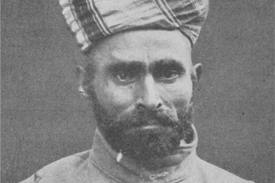
Khudadad Khan awarded Victoria Cross 31st October 1914
Hero or traitor?
The past week has seen an extraordinary attempt at revisionist history to pressurize Muslims to participate in and remember the events of the First World War. This post is in no way meant to belittle the courage of those who served on the front lines, in the trenches and in the most horrendous conditions. What is disturbing however is how the 100 year remembrance activities are being used to try to force Muslims to declare their “Britishness” and (if we are honest) wave a sometimes uncomfortable flag of patriotism.
For years I have been among a minority highlighting that remembrance is not a purely white event but that it is essential that we remember that many who fought on the battlefields of Europe and beyond were in fact from what was once British India and the British West Indies. An estimated 500,000 Africans were also deployed in the French and British forces, some as labourers, others as fighting soldiers.
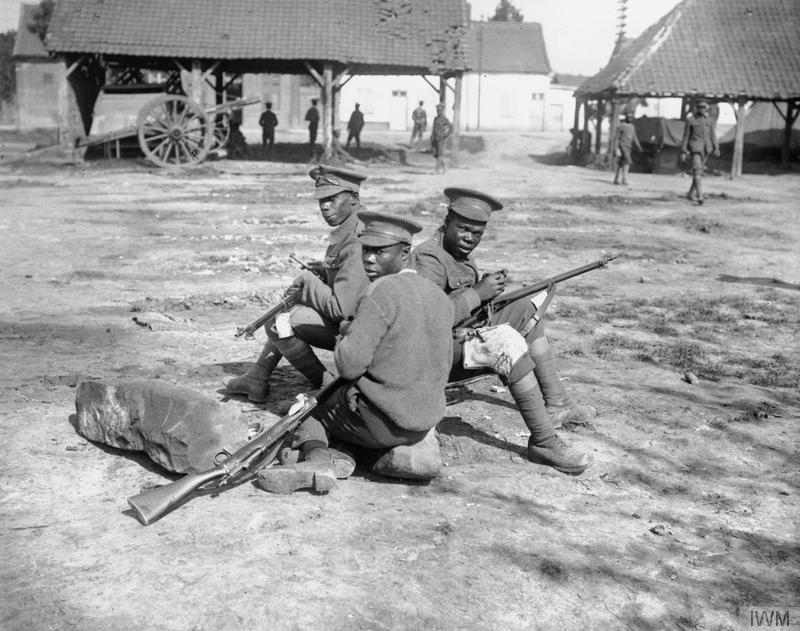
Men of the British West Indies Regiment cleaning their rifles; Albert-Amiens Road, September 1916
On remembrance day, we do see members of the Commonwealth gather at the Cenotaph in Whitehall, London to lay their wreaths of poppies but history taught in schools does not always reflect the diversity of serving soldiers. We may be very familiar with Wilfred Owen and Siegfried Sassoon through their war poetry, taught as part of school curriculum but the contributions of Sepoy Khudadad Khan (awarded the Victoria Cross) and black officer Walter Tull have until very recently largely been erased from history.
Tull was born in Folkestone in April 1888, Walter’s father, the son of a slave, had arrived from Barbados in 1876. He was a professional footballer and after joining the army became the first black officer to lead white British soldiers in battle.
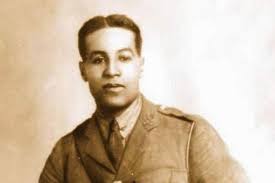
Walter Tull was killed by machine gun fire while trying to help his men retreat.
In recent days we have witnessed the launch of women sporting a “poppy hijab” as the BBC said in their headline, “to mark Muslim soldier’s Victoria Cross 100 years on” (referring to the remarkable achievement of Kudadad Khan). According to a letter written to the Telegraph signed by General Lord Dannatt, Former Chief of the General Staff and a number of other well known co- signatories in support of valuing Khan, “he was just one of the 1.2 million Indian soldiers, and the 400,000 Muslims, who fought alongside British troops in 1914”. The BBC states that Khan, born in what is now Pakistan,
“was the sole survivor of a team assigned to defend vital ports in France and Belgium from being taken by German troops.
Despite being outnumbered, Khan managed to hold off the enemy advance long enough for British reinforcements to arrive”
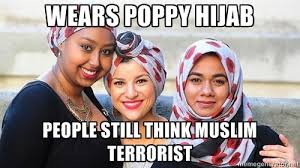
The introduction of the poppy hijab to celebrate centenary events and raise money for soldiers is promoted by a “think tank” British Future and various media but has not gone quite according to plan. For a start, one of the young women featured wearing the headscarf is now claiming she was not informed this was for a national campaign and thought she was only posing for photographs for a designer friend. She has apparently suffered some backlash from fellow Muslims and is clearly not happy that she was unable to make an “informed choice” regarding participation in a somewhat controversial campaign.
From comments received on a photo of Khudadad Khan which I posted on Facebook, not everyone considers him a hero. Though many will honour him, some Muslims describe Khan as a “traitor” for serving colonists. We must remember that in 1915 there was in fact a Sepoy uprising in Singapore against the British by those who saw themselves deployed to look after imperial interests and often treated as second class citizens.
The last straw was said to be “a rumour that the Sepoys were to be shipped to the European theater and made to turn their weapons against the Turkish sultan, a fellow Muslim”. The mutiny lasted nearly seven days, 47 British soldiers and local civilians lost their lives. Eventually the situation was brought under control by British forces and Allied naval detachments. Forty five members of the 5th Light Infantry mutineered against their “oppressors” which led to twenty two men being executed for their revolt.
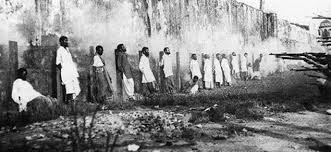
Sepoy uprising 1915, mutineers shot to death
The poppy hijab and highlighting of Khudadad Khan is now being used very publicly as a propaganda tool to attack jihadist group, Islamic State (IS) in Iraq and Syria. This is an ill-advised attempt to counteract the fact that some Muslims from the UK, already disillusioned with British foreign policy and our wars in Iraq and Afghanistan are heading off to join IS fight against the Assad regime in Syria. Using forgotten and only recently resurrected Muslim soldiers from the past to attack in the present will likely lead to more resentment.
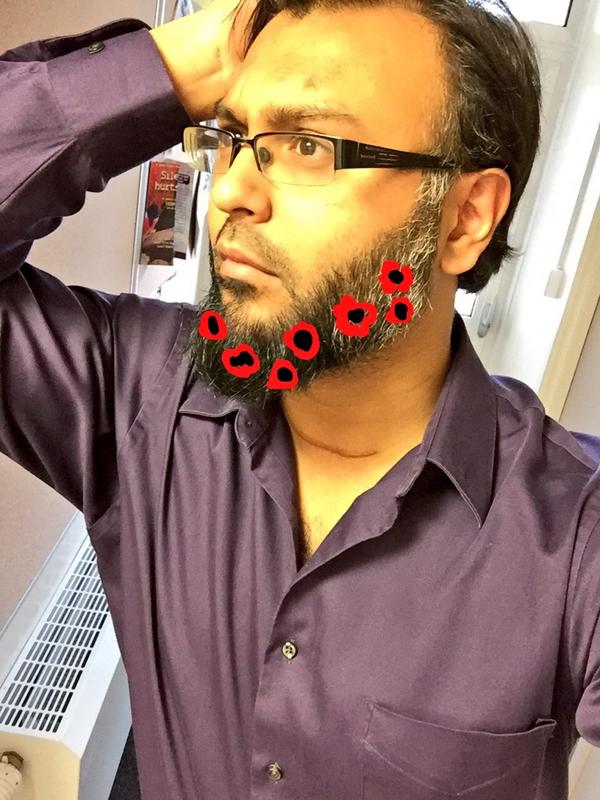
A satirical response to the poppy hijab
Muslims in Britain have never felt so under scrutiny to account for themselves and prove their loyalty. Those that who have shown no support for IS are now declining to be coerced into campaigns to promote Britishness as the hypocrisy of the establishment is not lost on them. They express feeling manipulated that suddenly there is great emphasis on celebrating Muslim soldiers of the First World War that few cared to remember over the past 100 years. In a satirical swipe at the poppy hijab, (and not to be left out) a photo appeared of a man sporting poppies in his beard, having a dig at the freshly created history of “tolerance for diversity” in the armed forces.
When I began tweeting on this hypocrisy myself, I suddenly received replies from Matthew Rhodes of British Future initially polite who tried to ensure that I tweeted the “right” version of history. Rhodes is a solicitor who previously worked for the Rt Hon Stephen Timms MP. Another member of the organization Sunder Katwala also dropped in to the conversation to remind me that there was a book too, “A God in Every Stone” from Pakistani novelist Kamila Shamsie. This was described in the Guardian as a fictionalized account of “the bonds between Pashtun men – in Flanders and during the struggle for Indian independence, captured in this wartime story of a London archaeologist’s travels to Peshawar” ….see the following link,
http://www.theguardian.com/books/2014/apr/18/a-god-every-stone-kamila-shamsie-review-story-histories
Over a period of several hours I was repeatedly trolled by an increasingly irate Mr Rhodes who did everything in his power to force me to condemn the actions of IS. I had absolutely no intention of doing so, for the simple reason that whatever my personal views might be, I do not respond to outright intimidation.
Rhodes became increasingly paranoid and vile attempting to put words into my mouth and tweeting statements that I had never uttered in a public attempt to defame me. He then tried to allege that I did not support human rights, questioning my loyalty to Britain. What I had in fact highlighted was the failure of British government to protect human rights which should not be selective and must apply to all.
I believe I was remarkably patient with Rhodes considering his attack on British Muslims and attempts to coerce me into making statements against my will. Like a terrier dog at my heel, he would have given Jeremy Paxman a run for his money with his interrogation style. This attack on my loyalty to country really irritated me given the fact that the British government are not actually deserving of any loyalty from me. They (alongside US authorities) unlawfully killed my husband and brother in law and many others in what can only be described as “bio-terrorism” and then covered up their wrongdoing!
This remembrance Sunday I won’t be wearing a poppy hijab but I will be thinking quietly of all those that have served their country in wars past and present whatever their race and religion. The emphasis will not be on “glorious victory” but on how many soldiers were manipulated by the state for the British government’s own interests. I will remember the terrible reality of war and how our nation has exploited other countries, plundered their resources, abused and annihilated local populations as in Iraq and Afghanistan.
I will also say a prayer for my grandfather Gunner Thompson who fought at Ypres and in the Battle of the Somme. Fred was a young man who saw his commanding officer blown to pieces in front of him and suffered the horrors of mustard gas, treated in a Canadian field hospital for exposure. I still have his first weeks pay, coins on a piece of string and his gas card. The only time he vocalized the First World War war was in his dying hours when delirious, Gunner Thompson once again relived the nightmare of his time in the trenches as he lost the exhausting and final battle for life.
Carol Anne Grayson is an independent writer/researcher on global health/human rights and is Executive Producer of the Oscar nominated, Incident in New Baghdad . She is a Registered Mental Nurse with a Masters in Gender Culture and Development. Carol was awarded the ESRC, Michael Young Prize for Research 2009, and the COTT ‘Action = Life’ Human Rights Award’ for “upholding truth and justice”. She is also a survivor of US “collateral damage”.

 Carol Anne Grayson (Radical Sister) blog