

“Battle of Algiers”, the colonizers and the oppressed
The films Battle of Algiers (1966) and Paradise Now (2005) though set almost 40 years apart are both films which deal with the ongoing international theme of terrorism within lands occupied by colonists/ oppressors. In order to explore the question of the relationship between violence and occupation it is important to define the word “terrorism” and consider within each film to whom that term might apply. For this purpose I quote the CIA definition of terrorism,
The term “terrorism” means premeditated, politically motivated violence perpetrated against non-combatant targets by subnational groups or clandestine agents, usually intended to influence an audience.
The term “international terrorism” means terrorism involving the territory or the citizens of more than one country.
The term “terrorist group” means any group that practises, or has significant subgroups that practice international terrorism.
(Central Intelligence Agency, 2002: www.cia.gov )
Battle of Algiers made in black and white and set in the city of Algiers was based on the memoirs of military commander of the National Liberation Front (FLN), Saadi Yacef, a former prisoner of the French and explores the war of independence within French occupied Algeria between 1954 to 1960. Director Gillo Pontecorvo was also heavily influenced by the work of writer and psychiatrist Frantz Fanon who examined the psychological effect of colonization on a nation living with domination and oppression and the growth of a resulting movement towards decolonization as portrayed in his book Wretched of the Earth (1961).
In the first film we follow a group of FLN insurgents as they take over the casbah and plan terrorist activities against the French. Pontecorvo explores the move towards a more radical Islamism with a growing clampdown on western influences such as alcohol and a more liberal dress code with an emphasis on ridding the streets of both Algerian criminals and traitors spying for the French. In the film Pontecorvo portrays an organised response to the violence perpetrated by the French invaders who attempt to suppress “native” resistance by any means necessary.
The colonists provoke an uprising by determining who will be allowed to move in and out of the casbah, curbing freedoms and governing through their own laws as they adopt a supremist mentality and display a lack of morality which degrades and dehumanises the colonized Algerians. As we enter the lives of those living within the walls of the casbah subjected to discrimimination, violence and poverty we are reminded of the words of Noam Chomsky, (author, linguist, philosopher and political activist). He argues that, the oppression of states is often to ensure that supplies of raw materials and cheap labour keep flowing to western corporations and that the arming of regional powers to destablize neighbouring countries could be described as the “real terrorist network” (Karim, 2002: 102).
The viewer is encouraged to explore the reactionary anger as felt by the colonized as plans are made to bomb a French cafe where both women and children are recruited to assist with the smooth running of the operation. The women become mules, carriers of explosives whilst a young boy acts as messenger for the insurgents including key character Ali La Point, a local criminal recently out of prison. It is through Ali’s eyes that the action unfolds.
One particular scene shows how the Algerian women recruited to carry the bombs abandon their traditional dress and go through a process of physical transformation to mimic the dress code of French women in order to both exit the casbah (bombs in handbags) through a security checkpoint and enter their target the Parisian influenced coffee bar.

Algerian women adopt dress code of French women in order to avoid suspicion when planting a bomb
The viewer is caught up in the tension of a “minute by minute” countdown as we follow in the footsteps of the three women who become complicit in acts of terrorism. There is also a challenge to gender stereotypes on screen and in the media that tend to portray terrorists as male, suggesting women as the “homemakers”/ “nurturers” are incapable of such acts. In reality we have examples of the Chechen widows and the female Tamil Tigers in Sri Lanka.
Although it is uncomfortable viewing we are to some extent allowing ourselves to be “guided” by Pontecorvo to engage with these young women in Battle of Algiers and in terms of understanding, consider how they might have allowed themselves to become competent carriers of destruction. They does not detract however from the horror of the “terrorist” attack as we see the cafe explode into a cloud of white with casualties emerging dazed and injured from the broken building.
The film does not shy away from depicting the violence perpetrated by both sides as we also witness the systematic torture, intimidation and murder inflicted on locals by the French colonizers, in this case a group of paratroopers. We also witness the internal conflict experienced by French Colonel Mathieu as comparisons are made with regard to his own earlier experience as a resistance fighter against the Nazis so we are made aware he has himself battled against an occupying force yet now becomes the occupier. How then does he adjust to his role in Algiers as part of a colonizing army and what sympathies might he hold for those who raise a violent struggle to bring about decolonization?
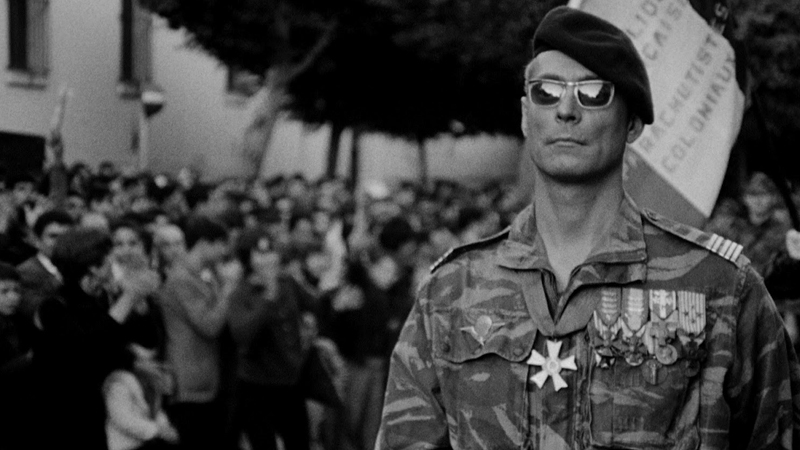
French Colonel Mathieu who has been both resistance fighter and occupier
Viewing Battle of Algiers in 2014 we are reminded of current occupying forces in Afghanistan and Iraq and resistance movements within those territories and the ongoing conflict within Israeli-occupied territories who inflict their own powers of colonization onto the Palestinians as seen in Paradise Now.
The camera work often looks down on the occupied who retain a lower position in society in every way than the occupiers. The soundtrack can be heard to conjure up resistance by using the repeated drum roll of the marching Algerian protesters alongside the traditional chants and wailing of the local women. It is a soundtrack of violence once again reflecting the nature of occupation and resistance through gunshot, screams, explosions and the machinery of war. We also have an accompanying score which enhances the drama of fear, conflict and battle through the music of Ennio Morricone.
It is important to recognise the role of both the book, Wretched of the Earth (Franz Fanon) and the film, Battle of Algiers in influencing later resistance movements particularly the rise of the Black Power movement in the US against white oppressors who denied Blacks their civil rights.
Later works by Black Panther activists such as Huey P Newton, Malcolm X, Eldridge Cleaver and Angela Y Davis incorporated much of Fanon’s thinking into their own political ideology and led some individuals and groups to engage in violent struggle against the State. Battle of Algiers is also used as a training film to assist the US defence department at the Pentagon to understand Islamism and engage with the thought processes of the colonized thereby entering the mind of the potential “terrorist”. Pontecorvo does show both sides of the Algerian conflict and it is largely a balanced portrayal of that period in history but it could be argued that his sympathies lie with the occupied as opposed to the occupiers.
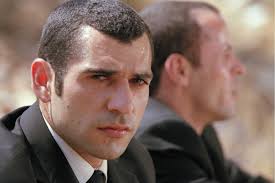
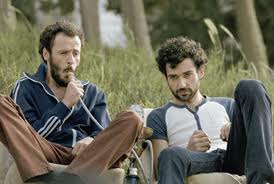
“Paradise Now” friends Said and Khaid prepare for their final hours
The second film Paradise Now directed by Hany Abu- Assad could be described as a “courageously honest” film as it dares to follow and depict the last 48 hours of two Palestinian friends Said and Khaled as they embark on a suicide mission against Israeli targets. As in Battle of Algiers we sense a longing for freedom, the resulting frustration when freedom is denied and increased anger and isolation as both men prepare for the ultimate sacrifice for the “cause” and contemplate their existence within an occupied land. Both films show the impact of colonization on the psyche of the colonized.
In a comparative scene to the women preparing for their terrorist mission in the earlier film, we see the young Palestinians undergo a similar physical transformation as they shave off their hair and beards and change into “western” suits to mimic the dress of Israelis.
Tension is built within the mundane process surrounding the technicalities of preparing for a suicide mission. We hear the contrast between the poignancy of a person’s last words to his family against the munching of food by seemingly unmoved associates as they battle with the camera and realise they have omitted to include a film so that the martyrdom videos must be reshot from beginning to end. We sense the exasperation and annoyance of Said as he attempts to vocalise the reasons behind his actions whilst also leaving practical instructions to his mother on how to obtain a water filter (a reference to the lack of clean water in occupied Nablus).
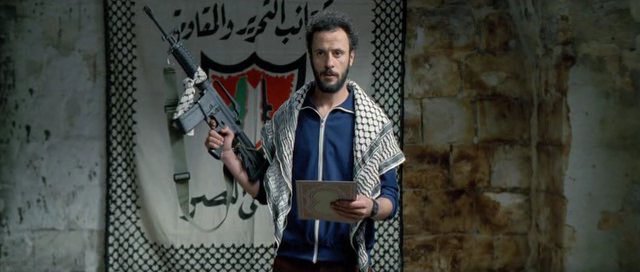
Last words for a martydom video
As in Battle of Algiers the viewer is confronted with the inequalities and discrimination experienced by the colonised in Nablus, here too we see walls, checkpoints controls, the lack of facilities and opportunities for the Palestinians with the two young men in dead end jobs holding few prospects for the future.
There is an ongoing dialogue throughout the film between Said and Suha, a young European educated woman and potential love interest whose own father was involved in violent conflict and her own rejection of violence as a tool to fight colonization. In contrast Said is the son of an informer and carries the burdon of this legacy wishing to prove his loyalty to the movement of resistance. As we see things through the eyes of several characters and learn of their viewpoint we are forced to consider what our own morality and boundaries might be given a similar life experience of growing up oppressed under the control of an external enemy.
Again there are similarities with the earlier film through the tense “moment by moment” countdown and effort required to actually reach the intended terrorist target. Neither Suha nor the families of the two men are aware of the young mens’ intended suicide mission but sense impending doom as certain clues emerge which might suggest that this is a final good-bye.
The film uses the dialogue between Said and Khaled and their leaders/mentors to explore the politics of Israeli occupation and the ideology of resistance as opposed to a more visual portrayal of the colonisers in Battle Of Algiers and we start to understand the relationship between occupation and violent retaliation. The colonized in both films feel degraded and dehumanised yet the portrayal of their characters on screen are very human portraying them as ordinary as opposed to extraordinary individuals with characteristics that are both good and bad.

Strapping on a suicide vest
In Paradise Now as in Battle of Algiers the viewer is engaged in witnessing the moral dilemma regarding a character’s actions. Paradise Now focuses on the two friends and their deliberation whether to continue on their suicide mission when things start to go badly wrong and the question arises – is there an alternative to violence for the colonized? The moral dilemma in Battle of Algiers is played out through the actions and words of Colonel Matthieu as he explores his own internal battle with his conscience.
We are reminded of the “doublethink” concerning war and occupation laid out by Kellner (2004: 148) where screen and other media can talk of a war for “peace”, present occupation as “liberation” and the destruction of necessary infrastructure as “humanitarian action”. Both films focus on realism and the viewpoint is predominantly through the eyes of the colonized taking us on a journey into the mind of the “other”. Although religion plays a part in both films with references to Islam and suggestions of Islamism we are always made aware of the violence of oppression perpetrated by hegemonic states and the effect on dominated societies.
Chomsky (2000) argues that “by referring to the actions of individuals against a state merely as ‘terrorism’, one separates them from state violence by marking them as evil, as unnecessary violence, as opposed to the murder of civilians or sponsorship of the same by the state (eg the US funding of ‘Contra’ death squads in South America)”.
Neither film sets out to portray the insurgents as “evil” but rather as end products of colonization and oppression and we begin to question who does come under the definition of a “terrorist”. If we return to the CIA guidance on what is “terrorism” we could argue that this very organisation itself could fit rather uncomfortably within the CIA’s own definition and could in fact be seen as carrying out state- sponsored terrorism.
Neither film glorifies violence or justifies terrorist acts but both draw attention to the relationship between violence and colonialism/occupation. By viewing both Battle of Algiers and Paradise Now the audience can see many parallels with regard to film technique, characterizations and socio-political representations of “terrorism” and “terrorists” and the “oppressor” and the “oppressed” within each film.
Carol Anne Grayson is an independent writer/researcher on global health/human rights and is Executive Producer of the Oscar nominated, Incident in New Baghdad . She is a Registered Mental Nurse with a Masters in Gender Culture and Development. Carol was awarded the ESRC, Michael Young Prize for Research 2009, and the COTT ‘Action = Life’ Human Rights Award’ for “upholding truth and justice”. She is also a survivor of US “collateral damage”.

 Carol Anne Grayson (Radical Sister) blog